What Is LangChain? A Complete Guide for 2026Updated: July 26, 2026
LangChain explained for developers: how it works, where it shines, where it breaks, and when to use LangGraph or LangSmith instead. Learn
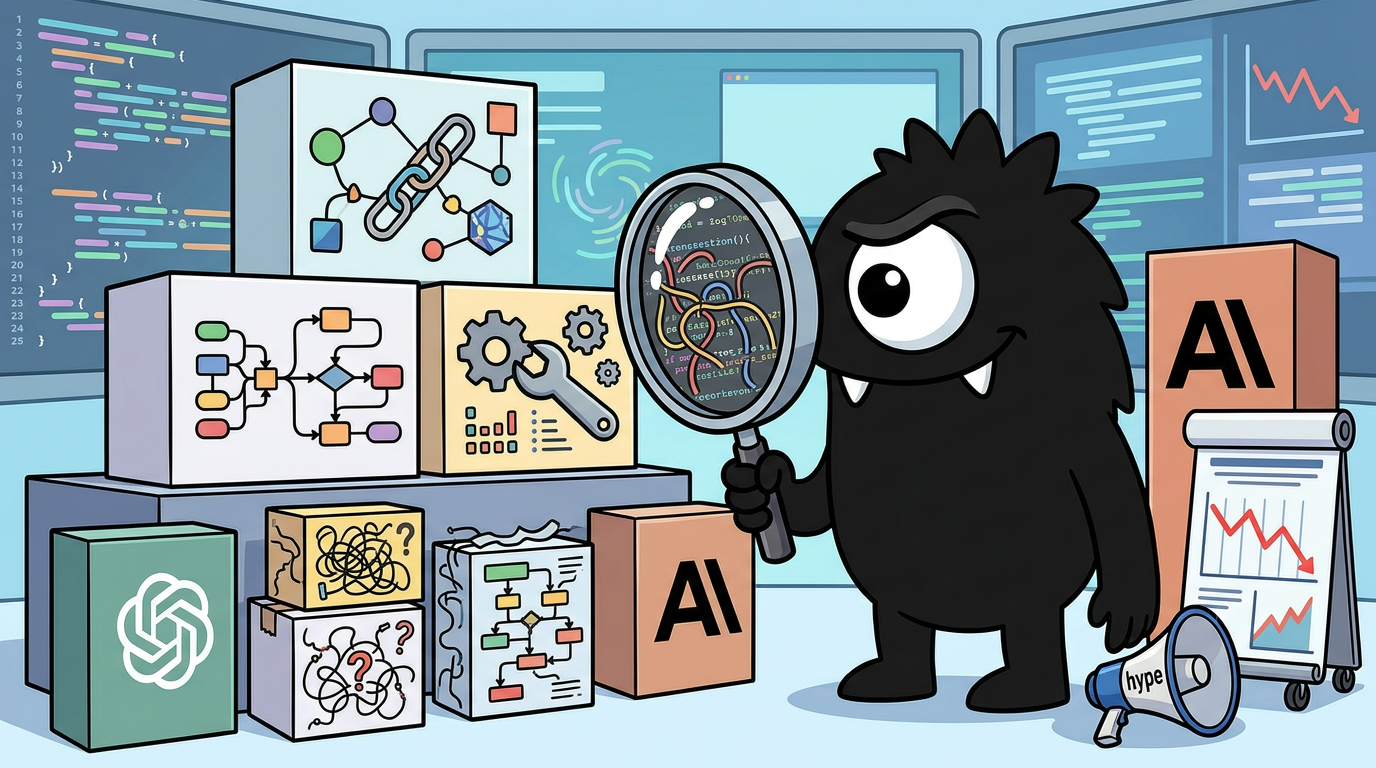
Why LangChain Exists: The Gap Between a Cool Demo and a Real AI App
LangChain became popular for a reason that critics sometimes underplay: LLM apps are not just model calls. The moment you move past a toy chatbot, you run into prompt templating, retrieval, tool invocation, output parsing, retry logic, conversation state, provider switching, and evaluation. LangChain emerged to modularize exactly those recurring patterns and give developers a reusable framework for composing them.[6][12]
That’s the gap the current X conversation keeps circling back to. A single prompt can look magical in a demo, but production systems fail in messier ways: context leaks, state disappears, tools return malformed outputs, and there’s no clean record of what happened when users complain.
LangChain’s SWE-bench jump from harness changes alone proves the point. Most teams are still optimizing the model while the surrounding execution layer leaks context, drops state, and has no real verification loop.
View on X →The optimistic case for LangChain is captured well here:
🚨 Most AI projects die at “cool demo.”
You build one chain, it works once, then hallucinations + broken context kill it. What if you could chain LLMs like Lego and actually ship reliable agents?
Enter LangChain (langchain-ai/langchain) — the open-source framework that became the de-facto standard for building production LLM apps.
I’ve shipped multiple tools with it and here’s the truth:
• RAG, agents, memory, tool calling, multi-step reasoning — all modular and composable
• LangGraph turns messy workflows into controllable graphs (state, cycles, human-in-loop)
• LangSmith gives you debugging superpowers (the missing piece everyone wishes they had)
• Perfect for indie hackers building AI wrappers, autonomous agents, or customer-facing tools without reinventing the wheel
This isn’t hype — it’s the infrastructure layer that lets solo builders compete with teams. Stop gluing APIs together manually. Start composing intelligence.
Who’s using LangChain (or LangGraph) in production right now? Drop your stack or biggest pain point below 👇 Tag a builder who’s still prompting manually!
🔗 https://t.co/AhDb27FSUh
#LangChain #AITools #Agents #OpenSource #IndieHacker
That post is promotional, but the underlying point is correct. LangChain spread because it let developers assemble RAG pipelines, agent loops, and tool-using apps faster than hand-rolling every integration and orchestration layer. Its homepage now reflects that broader mission: not just chaining prompts, but observing, evaluating, and deploying “reliable AI agents.”[6]
So if you want the shortest honest answer to “what is LangChain?” it’s this: LangChain is a framework ecosystem for building LLM applications that need more structure than raw API calls, but less bespoke infrastructure than a fully custom orchestration stack. The love comes from how much time that can save. The hate comes from what those abstractions cost once systems get real.
LangChain, LCEL, LangGraph, LangSmith: Why So Many Developers Feel Lost
A major reason developers talk past each other about LangChain is that “LangChain” no longer refers to one thing.
The confusion is real, and X users are right to complain.
I often think about how LangChain would've been a better framework if they provided a single unified framework to build agents.
Instead of multiple different ones.
> Deep agents to make "quick" agents
> LangChain because quick agents cannot be shipped
> LangGraph because LangChain abstracted a little too much.
> However what i do like is, LangSmith for observation throughout everything.
Ps : The confusion can be seen on their site asw 😭
No hate tho, they were still the early ones in the Agents/Rag space.
Here’s the clean mental model.
LangChain
At the highest level, LangChain is the application framework layer. It gives you components and patterns for prompts, models, tools, retrieval, parsers, and chains. If you are wiring together an LLM workflow from modular parts, you are in LangChain territory.[6]
LCEL
LCEL, the LangChain Expression Language, is the composition model underneath much of modern LangChain. It defines how “runnables” connect, stream, batch, and execute asynchronously.[4] In plain English: LCEL is how you declaratively wire components together without writing ad hoc orchestration code for every path.
This matters because it’s one of LangChain’s strongest technical ideas. Instead of every component exposing its own weird interface, LCEL pushes toward consistent execution semantics: invoke, stream, batch, compose. That consistency is useful when systems grow.
LangGraph
LangGraph is the lower-level orchestration layer for stateful, branching, durable workflows. LangChain itself describes the distinction clearly: LangChain is optimized for more linear workflows and fast prototyping; LangGraph is built for complex control flow and long-running, stateful agents.[2]
🔄 LangChain vs LangGraph
A technical deep dive comparing how LangChain and LangGraph handle AI agent workflows differently. LangChain optimizes for linear workflows and rapid prototyping, while LangGraph excels at complex conditional logic.
📚 Read the full comparison:
If your agent needs retries, cycles, approval steps, branching logic, resumability, or explicit state transitions, LangGraph is usually the more important piece.
LangSmith
LangSmith is the observability, tracing, evaluation, and debugging platform.[3] It’s where you inspect runs, analyze failures, compare outputs, and build evaluation loops around your application. In practice, LangSmith has become central to the production story because debugging agent systems without traces is miserable.
🦜🚀LangChain v0.1.0
After a year of development, we've released LangChain v0.1.0
Read the full blog here: https://t.co/k8znYgfeqE
After talking with the users and developers, we released this stable version and focused the library on a few core areas:
👀Observability: Building complex LLM applications is hard. In order to best debug, you need to know the exact steps that were taken and the input/output at each step. Through a tight integration with LangSmith, LangChain has best-in-class observability
↔️Integrations: With nearly 700 integrations, no matter what tech stack you want to use, LangChain supports it
🔗Composability: With LangChain Expression Language, it's easy (and fun!) to create arbitrary chains, bringing you all the benefits of a data orchestration framework
🎏Streaming: We've invested a lot in making sure that streaming is supported in a first class way for all chains created with LangChain Expression Language - including streaming of intermediate steps
🧱Output parsing: Getting the LLM to return information in a certain format is key for enabling it to take actions.
🔎Retrieval: adding advanced yet production ready methods for RAG, including text-splitting, retrieval, and an indexing pipeline
🤖Tool Use + Agents: collection of agents (decide what actions to take), collection of tools, easy way to define tools
We will be highlighting these individually over the coming week. Each one has a lot of nuance to it, and is worth it's own deep dive
Big thank you to our community for helping guide and build this with us!
So yes, the branding is confusing. What many people mean by “I use LangChain” in 2026 is actually some combination of:
- LangChain for components and integrations
- LCEL for composition
- LangGraph for orchestration
- LangSmith for tracing and evals
That’s powerful, but it also explains the recurring practitioner complaint: the ecosystem can feel like several overlapping frameworks instead of one opinionated path. Beginners struggle to know where to start. Experts struggle to know what to keep.
How LangChain Actually Works in Practice
Strip away the branding and a typical LangChain app is straightforward.
You usually combine:
- A model provider such as OpenAI or Anthropic
- A prompt template
- Optional retrieval, often backed by a vector store
- Tools the model can call
- Output parsers or schemas
- An orchestration layer to manage the sequence and state
LangChain’s provider ecosystem is a genuine strength here. Its integrations span major model vendors and infrastructure providers, which makes it easier for teams to swap back ends or support multiple ones over time.[12] That matters in production, where pricing, latency, and model quality can change faster than product roadmaps.
A basic example might be: take a user query, retrieve relevant docs, pass both into Claude or GPT, parse the result into structured JSON, call a pricing API if needed, then stream the answer back to the user. LCEL gives you a common abstraction for composing those steps, including async and streaming behavior.[4]
That is why developers evaluating the space often ask a question like this:
Currently learning the OpenAI Agent SDK - seems powerful so far.
But curious… should I dive into LangChain, LangGraph, or CrewAI instead?
Would love to hear what other builders are using for agents.
What LangChain adds over raw model APIs is not secret model capability. It adds composition, integrations, and operational consistency. If you’re building across OpenAI today and Anthropic tomorrow, or mixing retrieval, tool use, and structured outputs, that can be a real productivity boost.[12][6]
But that’s also the beginning of the backlash: the more a framework wraps, the more developers want to know exactly what it is doing on their behalf.
Why Developers Turn Against LangChain: Abstraction Tax, Breakage, and Debugging Pain
The anti-LangChain case is no longer fringe. It’s one of the loudest recurring themes in the developer conversation.
I recommend everyone against using LangChain and this article explains well
It uses abstractions on top of abstractions and actually makes your code needlessly complicated
Just write API calls and add a vector database instead
https://www.octomind.dev/blog/why-we-no-longer-use-langchain-for-building-our-ai-agents
That criticism lands because many teams have lived it. Early LangChain made it very easy to get something working quickly, but often by adding multiple abstraction layers between your code and the model API. As systems matured, those layers could become harder to reason about than the problem they were supposed to simplify.
The common complaints are familiar:
- Too many abstractions over simple API calls
- APIs and docs that changed rapidly
- Hidden control flow
- Hard-to-diagnose runtime behavior
- Codebases that became framework-shaped rather than problem-shaped
Langchain was never good, from day one, it's a mess, the docs are terrible, the specs changed 12 times and any project depending on it has a ton of code debt
Just roll your own solutions with decent specs and let codex iterate
Some of that is historical baggage. LangChain moved fast, and the early market rewarded speed over stability. But the criticism is not just “old opinions from 2023.” It reflects a real engineering pattern: once a team has to optimize latency, reliability, and maintainability, convenience abstractions get audited much more harshly.[7][8][9]
Latency is the most concrete version of the abstraction-tax argument.
Stop using LangChain for everything.
Built identical RAG pipelines: pure OpenAI calls vs LangChain.
Pure OpenAI: 120ms average response
LangChain: 340ms average response
The abstraction tax just cost you 220ms per query.
That single benchmark is anecdotal, not universal. But the principle is sound: every wrapper, parser, callback, trace hook, and orchestration layer can add overhead. For narrow, latency-sensitive applications, especially simple RAG or tool-calling paths, direct API calls are often easier to optimize and easier to understand.
This is why many experienced engineers now recommend a default posture that sounds almost boring: start simple, and only add framework layers when the problem actually demands them. If your app is one model call, one retrieval step, and one structured response, raw SDK calls plus a vector database may be the better architecture.[7][9]
That does not mean LangChain is bad. It means it is expensive in the same way any abstraction is expensive: you pay with indirection. If the framework saves you more complexity than it introduces, it’s a win. If not, it becomes debt.
The Real Battleground: Reliability, Tracing, and Production Operations
The most important shift in the LangChain story is that the center of gravity has moved from chaining prompts to operating systems.
That’s why LangSmith now matters so much. LangSmith’s docs position it as a platform for tracing, debugging, monitoring, and evaluating LLM applications.[3] The observability product page emphasizes inspection of execution paths, failure analysis, and dataset-driven iteration.[5] In other words: the company understands that the hard part of agents is not the first successful run, but the hundredth failed one in production.
The gap between an agent that demos and one that survives production is where most deployments fall apart.
LangChain just shipped two tools aimed at that gap.
LangSmith Engine: auto-diagnoses production agent failures.
LangSmith Sandboxes: secure isolated execution environments.
The production infrastructure era for AI agents is here.
This is where LangChain’s ecosystem has become more compelling than the framework alone. Once agents can call tools, branch, retry, and run for extended periods, you need answers to questions like:
- What sequence of tool calls happened?
- Where did latency accumulate?
- Which step produced the bad state?
- Can I replay this failure?
- How do I cluster similar incidents across thousands of runs?
- Can I safely execute code or tools in isolation?
Those are operations questions, not just dev-experience questions.
saw langchain shipped langsmith engine to cluster production failures into named issues. ran into this exact question last week trying to instrument our triage agent with otel spans, tool calls labeled cleanly but the reasoning step between them never had a span schema. curious if their clustering reaches into the reasoning trace or just keys off the tool-call sequence, our worst incidents are when one bad reasoning step poisons the chain...
View on X →That post gets at an important unresolved issue in observability for agent systems: tracing tool calls is relatively straightforward, but tracing reasoning quality is harder. Even when vendors expose intermediate traces, the semantics are often inconsistent, partial, or proprietary. LangSmith can help a lot with run-level visibility, but there is still an industry-wide debate about how deeply agent reasoning should be observed, standardized, and instrumented.
The push toward production infrastructure is also visible in LangGraph Cloud, which LangChain introduced as managed infrastructure for running fault-tolerant LangGraph agents with persistence, scaling, and integrated tracing.[1]
🚀 Introducing LangGraph Cloud 🚀
LangGraph helps you build reliable agents that actually work. Today, we've launched LangGraph Cloud, our new infrastructure to run fault-tolerant LangGraph agents at scale.
With LangGraph Cloud, you can:
• Handle large workloads with horizontally-scaling servers, task queues, and built-in persistence
• Debug agent failure modes and iterate quickly in a visual playground-like studio
• Deploy in one-click and get integrated tracing & monitoring in LangSmith
This builds on LangGraph v0.1, our latest stable release supporting diverse control flows - whether it's single- or multi-agent, hierarchal or sequential. You'll be able to create flexible agents with human-in-the-loop collaboration and first-class streaming support.
We can't wait to see the agentic workflows you'll ship. LangGraph Cloud is available in closed beta today.
👉 Join the waitlist for LangGraph Cloud: https://t.co/mhXUSMLdKd
✍️ Read our blog post announcement: https://t.co/sZlvT2BPl2
📽️ Watch the video walkthrough: https://t.co/t5NfEh6RNm
🌀 Haven't tried LangGraph yet? Give it a spin here: https://t.co/RUuGpLQetg
🙌 Check out the new LangGraph landing page:
That launch signaled something important: LangChain no longer wants to be seen primarily as a prompt-chaining library. It wants to own more of the runtime, the debugging loop, and the deployment substrate for agents.
Comparison with other observability tools also clarifies the positioning. As one practitioner put it:
How this compares to Braintrust / LangSmith
Honest take: (if you are reading until now, man we are besties)
Braintrust --> excellent for prompt eval, scoring functions, app logging. Strong when the unit under test is a prompt or single response.
LangSmith --> excellent for tracing/debugging LangChain/LLM apps. Great when observability + prompt datasets are the priority.
AgentClash datasets --> when the unit under test is a tool-using agent you need to regression-test in CI.
That framing is useful. LangSmith is strongest when your unit of concern is a traced LLM application or agent workflow, not just a single prompt. For teams running multi-step systems, that distinction matters.
The caveat is cost and architecture. Some developers object to tracing overhead, proprietary protocols, or split observability stacks. Those concerns are not theoretical, and they’re part of why LangChain’s production story is both stronger than before and more contested than ever.
Why LangGraph May Be the More Important Story Than LangChain Itself
If you zoom out, the real evolution in this ecosystem is from chains to graphs.
LangGraph is designed around explicit state, node transitions, cycles, and durable execution.[1][2] That is a better fit for production agents than linear prompt pipelines because real workflows branch, pause, retry, and involve humans.
In practical terms, LangGraph lets developers model systems more like software and less like glorified prompt templates:
- state persists across steps
- execution can resume after failure
- approval gates can be inserted cleanly
- branching logic is explicit
- nodes can be tested more deterministically
That’s why enterprise stories increasingly center on LangGraph rather than vanilla LangChain.
⚡ Building enterprise agents at Coinbase with LangSmith ⚡
Coinbase went from zero to production AI agents in six weeks, then cut future build time from 12 weeks to under a week.
Their Enterprise AI Tiger Team built a "paved road" so any team could ship agents the same way they ship code.
What made this work:
→ Code-first graphs with LangGraph & LangChain over low-code tools. Typed interfaces and unit-testable nodes beat prompt engineering for the use cases they wanted to scale.
→ Observability as a requirement. Every tool call and decision gets traced using LangSmith, our agent engineering platform.
→ Auditability by design. Immutable records of data used, reasoning followed, and approvals given.
Result: Two agents in production saving 25+ hours per week. Four more completed. Half a dozen engineers now self-serve on the patterns.
Agents are a software discipline. When you host them properly, make them observable end-to-end, and test what's deterministic, you get speed where it helps and rigor where it matters.
Read more:
You should read that as more than a customer win post. It’s a statement of product philosophy: typed interfaces, unit-testable nodes, and audited state transitions scale better than loose prompt orchestration. That is a serious argument, and for many enterprise internal platforms it’s probably right.
So while “LangChain” remains the umbrella brand most people know, LangGraph may be the more consequential product for 2026. It is the clearest answer to the strongest criticism of old-school chain abstractions: they were too implicit for systems that need control.
OpenAI Agents SDK, CrewAI, AutoGen, Pydantic AI: Where LangChain Fits Now
The framework landscape has gotten much more crowded, and the comparison question has shifted from “can this framework build agents?” to “what kind of engineering culture does this framework assume?”
hey @nicoalbanese10 can you drop something that explains more on how @aisdk differs from langgraph and some of the other providers? Would love a youtube video breaking this down.
Other providers include the following:
langchain / langgraph / OpenAI Agents SDK / Google ADK / etc
That’s the right question.
Alternatives differ less in headline features than in defaults and philosophy:
- OpenAI Agents SDK feels simpler if you are mostly staying inside the OpenAI world
- CrewAI emphasizes role-based multi-agent workflows
- AutoGen is often used for conversational multi-agent patterns
- Pydantic AI pushes hard on type safety, structured outputs, and standards-oriented engineering
- LangChain/LangGraph offers the broadest ecosystem and one of the deepest orchestration-plus-observability stacks
The sharpest critique from the competing camp comes here:
Congratulations to LangChain. The less you think of their tech, the more impressive this raise is!
But maybe this is a good time to remind everyone that there is a better alternative built on open standards and engineering rigor, that won't cost you more than your inference.
Here's how to compare the LangChain and @pydantic Stacks:
* if you want to use a proprietary tracing protocol, choose LangGraph and LangSmith; if you want to use OpenTelemetry, choose Pydantic AI and Logfire
* if you want separate observability platforms for engineering and AI, choose LangSmith + Datadog; if you think AI IS engineering and you want one platform, choose Logfire
* if you want to pay $500 per million traces (or $4,500 per million traces for increased retention), choose LangSmith; if you want to pay $2 per million spans, choose Logfire (yup, you read those numbers right)
* If you think type safety is an annoying irrelevance, choose LangGraph; if you think type safety is extremely useful for human developers and table stakes for AI developers, choose Pydantic AI
* If you know you're agent run will never take longer than ~10s and never need to survive a host restart, choose LangGraph; if you want to full durable execution with multiple backends, choose Pydantic AI
* If you think evals should be deeply integrated with the platform you view them on, choose LangSmith; if you think your evals harness should be open source and standalone, then emit OTel, choose pydantic-evals and Logfire
(This is a snarky post, but my congratulations are genuine. The LangChain team are clearly very effective at raising money, and marketing, and those are real skills. 🙌)
The snark aside, that post identifies the real fault lines: open standards versus proprietary plumbing, type rigor versus flexible abstraction, unified versus separate observability, and different models of durable execution. These are not cosmetic differences. They affect how your team debugs systems, how much vendor lock-in you accept, and how your agent behavior evolves over time.
And yes, framework choice can materially change outputs even when the prompt, tools, and model appear identical.
I built the same AI News Agent in 4 frameworks:
→ LangGraph
→ CrewAI
→ AutoGen
→ OpenAI Agents SDK
Same prompt. Same tools. Same model.
But they gave completely different results
Full comparison + code + lessons:
https://junaidshaukat.com/blog/four-agents-one-job
Which one would you pick? 👇
Why? Because execution models matter. Tool-loop behavior, retries, state persistence, prompt wrapping, defaults, concurrency, and parser behavior all shape what the agent actually does. The “same agent” in four frameworks is usually not the same agent at all.
LangChain still fits best when you need breadth: many providers, many integrations, a composable app layer, and a path into richer orchestration and observability later.[12][3][2] But it is no longer the uncontested default. It is one strong option among several increasingly opinionated stacks.
Who Should Use LangChain in 2026, and Who Should Skip It
The practical answer is not tribal.
You should use LangChain in 2026 if:
- you need to move quickly across multiple model providers and tools
- your application combines prompts, retrieval, structured outputs, and tool use
- you want a path into LangSmith for tracing and evals
- you expect the app may later graduate into LangGraph-level orchestration[6][1]
You should use LangGraph if:
- your workflow is stateful and branches
- you need retries, resumability, or long-running tasks
- humans need to approve or intervene mid-run
- you care about explicit control flow and durable execution[1][2]
You should skip LangChain and write directly against model SDKs if:
- your app is narrow and simple
- latency matters a lot
- you only use one provider
- your team values explicitness over framework convenience
- you would rather own your orchestration code than adapt to someone else’s abstractions[10]
And you should evaluate alternatives like Pydantic AI or provider-native SDKs if your priorities are stronger typing, tighter standards alignment, or simpler vendor-centric flows.
The most useful advice is probably the least exciting: do not adopt the whole LangChain ecosystem by default. Pick the layer that solves your actual problem.
- Need integrations and composability? LangChain.
- Need durable agent orchestration? LangGraph.
- Need tracing and evaluation? LangSmith.
- Need one fast endpoint with predictable latency? Direct API calls.
That’s why this post still resonates, even if you don’t agree with every complaint:
. @hwchase17 I've resisted dumping on @langchain publically until now (despite how easy it would be) but if you're going to start publishing BS like this, I'll stop being so restrained:
* LangSmith caused a well known AI company to pivot away from Python because its tracing mess hung for 500ms on every function call.
* LangChain is blocked in at least one major public tech company for security reasons.
It's pretty brave of you to start referring to other people's libraries as "not really production ready".
Pick a fight with @OpenAI if you like, but leave @pydantic out of it.
LangChain is the framework developers love and hate because both sides are reacting to something real. It genuinely helped define the first generation of LLM application engineering. It also genuinely imposed abstraction costs that many teams later regretted.
By 2026, the fairest verdict is this: LangChain is no longer best understood as a single framework. It is a toolkit and platform family for teams building beyond the demo stage. That makes it powerful — and easy to misuse.
If you choose it deliberately, it can accelerate serious AI product work. If you choose it reflexively, it can bury a simple app under unnecessary machinery.
Sources
[1] LangGraph: Agent Orchestration Framework for Reliable AI Agents — https://www.langchain.com/langgraph
[2] LangGraph overview - Docs by LangChain — https://docs.langchain.com/oss/python/langgraph/overview
[3] LangSmith docs - Docs by LangChain — https://docs.langchain.com/langsmith/home
[4] LangChain Expression Language — https://www.langchain.com/blog/langchain-expression-language
[5] LangSmith: AI Agent & LLM Observability Platform — https://www.langchain.com/langsmith/observability
[6] LangChain: Observe, Evaluate, and Deploy Reliable AI Agents — https://www.langchain.com/
[7] Why Smart Developers Are Moving Away from LangChain — https://medium.com/@ken_lin/why-smart-developers-are-moving-away-from-langchain-9ee97d988741
[8] Is LangChain Bad? Criticisms, Tradeoffs and Best-Fit Use Cases — https://techtidesolutions.com/blog/is-langchain-bad/
[9] Why we no longer use LangChain for building our AI agents — https://news.ycombinator.com/item?id=40739982
[10] 7 LangChain Production Issues That Push Teams to Offload — https://logic.inc/resources/langchain-production-issues
[11] Langchain is NOT for production use. Here is why .. — https://medium.com/@aldendorosario/langchain-is-not-for-production-use-here-is-why-9f1eca6cce80
[12] LangChain Python integrations — https://docs.langchain.com/oss/python/integrations/providers/overview
References (15 sources)
- LangGraph: Agent Orchestration Framework for Reliable AI Agents - langchain.com
- LangGraph overview - Docs by LangChain - docs.langchain.com
- LangSmith docs - Docs by LangChain - docs.langchain.com
- LangChain Expression Language - langchain.com
- LangSmith: AI Agent & LLM Observability Platform - langchain.com
- LangChain: Observe, Evaluate, and Deploy Reliable AI Agents - langchain.com
- Why Smart Developers Are Moving Away from LangChain - medium.com
- Is LangChain Bad? Criticisms, Tradeoffs and Best-Fit Use Cases - techtidesolutions.com
- Why we no longer use LangChain for building our AI agents - news.ycombinator.com
- 7 LangChain Production Issues That Push Teams to Offload - logic.inc
- Langchain is NOT for production use. Here is why .. - medium.com
- LangChain Python integrations - docs.langchain.com
- Anthropic (Claude) integrations - docs.langchain.com
- ChatAnthropic integration - docs.langchain.com
- Providers and models - docs.langchain.com
Related Guides

Perplexity AI vs Meta Llama: Which Is Best for Data Analysis and Reporting in 2026?
19 min read
Notion vs Webflow: Which Is Best for AI Pair Programming in 2026?
15 min read
What Is Vercel? A Complete Guide for 2026
18 min read
What Is Supabase? A Complete Guide for 2026
18 min read