HubSpot vs Surfer SEO vs ConvertKit: Which Is Best for Startup Founders and Solopreneurs in 2026?
HubSpot vs Surfer SEO vs ConvertKit for founders: compare CRM, SEO, email, pricing, and fit by growth stage to choose smarter. Discover
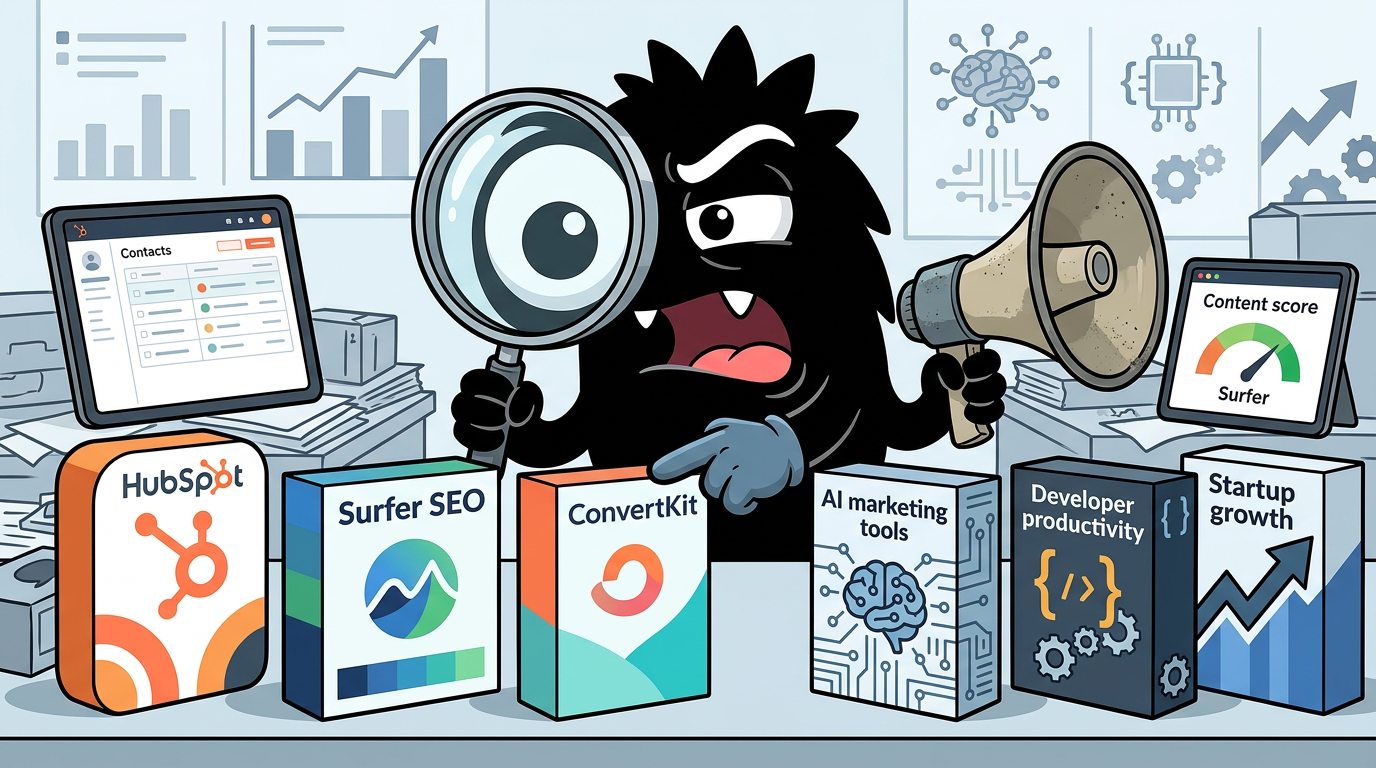
Why Founders Keep Mixing Up HubSpot, Surfer SEO, and ConvertKit
This comparison gets messy because these products often show up in the same founder “tool stack” conversations, even though they solve very different problems.
We are both trying to get the answer to this.
Please help!! What platform do we begin on??
I’m so confused by where @ConvertKit fits vs @beehiiv vs @substack
And where does @HubSpot fit?
Help!!
That confusion is understandable. A founder asking “What should I use?” is usually not asking for a taxonomy lesson. They’re asking: What is my next bottleneck? And that’s where these tools separate quickly.
- HubSpot is a CRM-centered customer platform. Its core job is to capture leads, organize customer data, manage pipeline, run marketing campaigns, automate follow-up, and support sales handoffs.[2][1]
- Surfer SEO is a search optimization platform. Its job is to help you improve content so it has a better chance of ranking in search and appearing in AI-assisted discovery flows.[7]
- ConvertKit, now branded as Kit, is an email-first creator platform. Its strengths are newsletters, landing pages, audience capture, monetization, and simple automations for direct audience relationships.[13][12]
X often flattens them into a generic “growth tools” category. That’s useful at a glance, but dangerous when you’re buying software.
For solo founders/builders,
ChatGPT/Claude → ideas + content
Canva AI → designs
Buffer → posting
Surfer SEO → growth
HubSpot → leads & email
No worries 😄
Let’s connect and grow together 🤝🚀
46 AI tools for SaaS founders:
1. Cursor
2. GitHub Copilot
3. Claude
4. ChatGPT
5. Lovable
6. Apollo
7. v0
8. Replit
9. Figma
10. SEO Wins
11. Uizard
12. Canva
13. Magic Patterns
14. Relume
15. Jasper
16. HubSpot
17. Writesonic
18. Rytr
19. Anyword
20. Typefully
21. Surfer SEO
22. Clay
23. Ahrefs
24. Frase
25. Clearscope
26. SparkToro
27. Taplio
28. Hotjar
29. Descript
30. HeyGen
31. Synthesia
32. ElevenLabs
33. CapCut
34. Opus Clip
35. Intercom
36. Tidio
37. Zendesk
38. Crisp
39. Zapier
40. Make
41. n8n
42. Gumloop
43. Relay
44. PostHog
45. Mixpanel
46. Perplexity
The practical takeaway: these are not three interchangeable choices for the same job. They are three answers to three different questions:
- Do I need to manage and convert leads? → HubSpot
- Do I need more organic visibility from content? → Surfer SEO
- Do I need to build and own an audience directly? → ConvertKit
They can absolutely coexist. But for most startups and solopreneurs, buying all three at once is a sign you haven’t identified the constraint clearly enough.
Start With the Goal: Leads, Organic Traffic, or Audience Ownership?
The smartest founders on X are no longer asking “What’s the best marketing tool?” They’re asking which system matches the growth engine they’re trying to build.
If your immediate problem is lead capture and follow-up, HubSpot is usually the cleanest answer. HubSpot’s starter platform bundles CRM, forms, email marketing, simple automations, and customer management into one system built for moving prospects through a funnel.[2]
If your problem is content that exists but doesn’t rank, Surfer is more relevant. Its toolkit is built around content optimization, audits, SERP-informed recommendations, and broader search visibility.[7]
If your problem is building an owned channel — newsletter, waitlist, direct founder brand, educational funnel — ConvertKit fits that founder-led model better than a full CRM.[13]
The long-term framing matters too.
A changed I've made that I think will make me a LOT more money and have WAY MORE fun: having longer time horizons!
In my 20's, it was all about working backwards from an exit.
I think that strategy was GREAT for that time. Aiming for financial freedom while young is wonderful.
But now, I am really trying to create things that can last 10, 20, 50 years.
A few things I think about for this:
1. 𝗖𝗼𝗺𝗽𝗲𝘁𝗶𝘁𝗶𝘃𝗲 𝗮𝗱𝘃𝗮𝗻𝘁𝗮𝗴𝗲 - most people aren't missionaries in this game. They're mercenaries (like i was). Get in, get out. But being a cockroach and outlasting others is a competitive advantage.
2. 𝗖𝗼𝗺𝗽𝗼𝘂𝗻𝗱𝗶𝗻𝗴 - I didn't understand this until recently. But man, if you set things up well, compounding is amazing. If you're at $10m in sales in year 7 and grow 25%/year, by year 17 you'll be at $93m! At 30%/year, you're at $137m in year 17! I wanted to 2-3x my business each year. GREAT GOAL. But it for sure stressed me out and wore me down.
25%/year is hard, but its doable.
3. 𝗜𝗻𝘀𝗽𝗶𝗿𝗮𝘁𝗶𝗼𝗻 - Now, trusting that +20 years is worth it and will pay off. Very hard. The pain of the crappy days for sure makes me want to quit sometimes.
Things that've helped me are talking to other people who've been there/done that, like the folks in my group in @HamptonFounders or the wider network. Seeing their stories/feedback/regrets/wins has changed me. I just steal what their doing (or wished they did).
Reading biographies helps a ton, too.
Also, I LOVE startups who share their revenue. My fav is @nathanbarry + ConvertKit. ConvertKit kinda stunk at first. High churn, low revenue growth. But over last 10 years...most the numbers improved for most (but not all) quarters. Inspires me that it can work out.
Same with @awilkinson's Tiny, which is now public. I can see all his past numbers!
4. 𝗥𝗲𝘄𝗮𝗿𝗱 - Selling early CAN be worth it. It was for me. Why? Because I was kinda poor for most of the journey. I thought it was cool to pay myself very little ($30-40k/year) because I didn't want to be selfish. Stupid. Now, I pay myself a lot more. I take a % of profits. Which means I optimize for profit by default.
Now, I'm not saying I won't ever sell. If I get bored or my tastes or life circumstances change, maybe it'll happen.
But by defaulting to a longer time horizon, I've found myself much, much happier.
PS: but if you wanna give me $200m for Hampton right now...DM me ;) KIDDING.
And that logic is exactly why Nathan Barry and ConvertKit show up so often in founder conversations about career leverage and business durability.
I asked Nathan Barry, the founder of ConvertKit (a $250 million business), what his #1 tip is for building an audience and using it to supercharge your career.
Here is his response:
There’s also a stage question here:
- Pre-product or pre-traction: ConvertKit often makes more sense than HubSpot because you need signal, subscribers, and feedback more than pipeline stages.
- Early traction with content potential: Surfer can matter if SEO is already part of acquisition and you have pages worth improving.
- Post-PMF or team-based selling: HubSpot becomes much more compelling when leads, lifecycle stages, and handoffs create operational drag.
You can also see this stack thinking in broader founder resource lists, where Kit is categorized under growth rather than CRM or SEO.
🚨 50 websites every founder should know before starting a startup.
💰 Validate your idea
GummySearch
Exploding Topics
Google Trends
https://join.trends.vc/
AnswerThePublic
AlsoAsked
YC Requests for Startups
Product Hunt
Indie Hackers
Hacker News
🎯 Landing Pages
Framer
Typedream
Carrd
Unicorn Platform
Webflow
Dorik
Tally Forms
Fillout
https://t.co/zLGQqzuAnD
Crisp
💳 Payments
Lemon Squeezy
Polar
Paddle
Stripe Atlas
Gumroad
ThriveCart
Payhip
Fourthwall
Whop
Ko-fi
📊 Analytics
PostHog
Plausible
Mixpanel
Microsoft Clarity
Hotjar
Ahrefs Webmaster Tools
Similarweb
Semrush
UptimeRobot
Better Stack
🚀 Growth
Buffer
Metricool
Kit (ConvertKit)
https://t.co/xrc69M5lus
Clay
Instantly
https://t.co/W2meSb0IKk
SparkToro
Common Room
Taplio
HubSpot: Best for CRM-Centered Growth, but Only if You’ll Use the System
HubSpot wins when your startup needs a system of record for revenue-related activity, not just a way to send emails.
At its best, HubSpot combines:
- CRM
- forms and lead capture
- email marketing
- automation/workflows
- sales pipeline management
- reporting and lifecycle tracking
That “all-in-one” promise is why it keeps getting treated as a growth operating system, not just another marketing tool. HubSpot’s starter offering is explicitly aimed at startups and small businesses that need customer management plus marketing and sales basics in one place.[2] The company’s startup program also offers discounts and support for eligible early-stage companies,[1] including specific bootstrap-focused offers.[4]
That changes the economics more than many founders realize. Full-price HubSpot can look expensive fast, especially once you move up tiers.[3] But if you qualify for startup pricing, the decision is less “Can I justify enterprise-ish software?” and more “Am I ready to operationalize inbound properly?”
HubSpot went from a two-person MIT idea to $3.13B in revenue. The inbound marketing playbook they invented is now used by 288,000+ companies.
All about @hubspot
https://yespress.io/hubspot-crm?utm_source=twitter&utm_medium=social via YesPress
Here’s the key caveat: HubSpot is only valuable if your team will actually run its process inside the system. If you’re still managing leads from DMs, manual spreadsheets, and scattered inbox threads, HubSpot can become expensive shelfware.
This is the real tradeoff behind X debates. People compare HubSpot with lighter email tools because they feel the overlap on the surface.
I want to do @pootlepress-esque speed build challenge but for CRMs/Marketing Automation platforms.
@Groundhoggwp vs @ActiveCampaign
@Groundhoggwp vs @HubSpot
@Groundhoggwp vs @ConvertKit
Any challengers?
That matters when you have:
- inbound demo requests
- multiple lead sources
- lifecycle segmentation
- sales follow-up tasks
- attribution questions
- more than one person touching the customer journey
It matters a lot less when you’re a solo founder with one newsletter and one landing page.
HubSpot also deserves credit for pushing founders to think beyond classic SEO toward broader discoverability. AI search and AEO are not speculative side topics anymore.
I thought AEO (read: SEO for LLMs) was a hunk of bullsh*t.
And then i spoke to @kippbodnar, CMO of @HubSpot, who knocked the skepticism out of me.
His first jab: In one year, they grew AI search traffic by 15x. It went from rounding error to real line item on the P&L.
His second jab: AI search conversion rates are 5x higher than Google search. On some queries, 13x higher.
His hook: 60% of AI citations don't come from the top 20 Google results. The companies dominating Google aren't automatically winning in AI search, which creates a huge advantage for early adopters.
He then took me through his process for crushing AEO & seeing results in days, not months (like SEO):
1) Grade: your current AEO presence across ChatGPT, Perplexity, and Gemini with a tool like Hubspot's AEO grader.
2) Restructure: your content into chunked, answer-first pages with natural language headers.
- one consolidated page, not 8-10 interlinked pages
- lead with natural language questions like "What is X?"
- 1-2 paragraph sections, not 1,000 word sections
- table of contents on a single page
3) Separate: Mentions from citations and optimize differently for each
- Mention = when AI references your brand or product in its answer but doesn't link to you
- Citation = when an AI references you AND links to your page
4) Open up: your information — ungate content, build Reddit presence, make pricing public
- Optimize for entity understanding: how well do AI models understand what your company does, based on every signal from Reddit to review sites, awards lists to help docs
5) Tool up: with AEO-specific software to track prompts and share of voice
- Check out Xfunnel or Limey[.]ai
6) Rethink attribution: measure source of customers, not source of traffic.
- Metrics that matter: share of voice, citation count, sentiment, mention frequency, source of customers not traffic
My opinion: HubSpot is not “too much tool” by default. It’s too much tool for founders who haven’t yet earned the complexity. But once your growth problem is orchestration rather than raw traffic, it’s often the most complete answer in this comparison.
Surfer SEO: Best for Search-Led Content Teams and Founders Chasing Compounding Organic Growth
Surfer’s value proposition is much narrower than HubSpot’s — and that’s a strength, not a weakness.
Its core job is to help you move content from published to competitive. Surfer analyzes top-ranking pages and gives guidance on structure, topical coverage, keyword usage, content depth, and optimization opportunities.[7][10] More recent positioning also includes AI search visibility, reflecting the shift from old-school SEO toward broader answer-engine discoverability.[7]
That’s why experienced practitioners describe it less as a magic ranking button and more as a disciplined optimization layer.
We rank our clients in the top 3.
Want to know one of the tools we use to get them there?
SurferSEO
It’s a tool we use when building service pages and blog posts for clients, and it’s genuinely useful.
It helps give a clearer steer on things like page structure, topical coverage, NLP and entity terms, what the current top-ranking pages are already doing and what google is broadly expecting to see on a topic. And now, it also gives you AI Search info to cover too.
So it's not just looking at traditional SEO signals, it's also trying to show you the kinds of information LLMs are likely to cite and pull into AI search.
When I'm building a page, I’m not just thinking about organic rankings, I'm also thinking about whether the page covers the right information clearly enough to be surfaced in AI-generated answers too.
So, I often start inside Surfer’s content editor.
That means the page is being shaped with data, not guesswork.
But... Surfer is only part of the job.
What it doesn't tell you is:
-what your market actually cares about
-what is most likely to convert
-how to shape the page commercially
-how it should support your Google Business Profile
-how it fits into your internal linking
-how it supports the wider topical cluster
-and where the real opportunity gaps are against competitors
That's the work we do around the tool and that's usually where the results come from.
The pages that perform best are not just well optimised in Surfer, they're built around search intent, customer questions, commercial relevance, site structure, internal links, local SEO, and the wider strategy behind the site.
So if you're using Surfer and not getting much out of it, the problem is probably not the software, it's probably everything around it.
It's a very good tool, but on it's own, it's not enough.
Want content that ranks? Get in touch.
That post captures the reality well: Surfer is useful for shaping pages with data, but it does not replace strategy. It won’t tell you:
- what your market actually cares about
- which topics align with revenue
- how a page fits your internal linking structure
- whether your content maps to commercial intent
This is where a lot of founders misuse SEO software. They expect a tool to create demand strategy when the tool is really there to improve execution quality.
Creating content isn’t enough. Ranking needs strategy.
We reviewed Surfer SEO to see if its content optimization, keyword research, and audit features actually help improve search performance.
Read the full review: https://seo.saastrac.com/surfer-seo-review/
#SEO #ContentMarketing #SaaS
That’s also why Surfer is strongest in specific contexts:
- content-led SaaS
- agencies
- local/service businesses publishing money pages
- startups with existing blog libraries or landing pages
- teams that already know SEO contributes to pipeline
If you publish two blog posts a quarter and have no process for distribution, internal linking, or conversion design, Surfer will feel expensive relative to value. And pricing sensitivity is very real. Surfer’s pricing is straightforward compared with broader platforms,[8][9] but straightforward does not mean cheap in a lean bootstrapped stack.
Too many expensive SEO tools...
Surfer SEO - $79
Semrush - $139
Ahrefs - $129
As a SEO sucker I'm looking for free tools.
That complaint is not just budget whining. It reflects a bigger market truth: SEO software only pays for itself when SEO is connected to outcomes. If one improved page brings qualified demos or sales, Surfer is easy to justify. If it only nudges vanity traffic, it isn’t.
One more nuance for 2026: search is now partly about whether LLMs can parse, summarize, and cite your content. Surfer’s AI-search framing is directionally correct, but don’t confuse tool support with guaranteed visibility. You still need clear pages, answer-first formatting, and topic authority.
Bottom line: Surfer is not for “doing SEO” in the generic sense. It’s for teams serious enough about content to optimize it like an asset.
ConvertKit: Best for Founder-Led Audience Building and Lean Email Automation
ConvertKit — now Kit — remains one of the best fits for founders whose business depends on direct audience ownership.
Its product positioning is clear: email marketing, landing pages, forms, automations, and creator business monetization tools for people building an audience they can reach without intermediaries.[13] Pricing is also staged around creator business growth rather than classic CRM complexity.[12]
That makes it especially attractive for:
- newsletters
- lead magnets
- waitlists
- educational funnels
- personal-brand-led startups
- creator founders selling products, memberships, or services
On X, ConvertKit is often described as the middle ground between beginner newsletter tools and heavyweight automation suites.
2/ Compare features
• For simplicity, Mailchimp is great for beginners.
• For more advanced automation, ConvertKit or ActiveCampaign stand out.
• Large-scale businesses might benefit from HubSpot or Klaviyo.
Its biggest strategic advantage is simplicity. A solo founder can launch a landing page, connect a form, start a sequence, segment subscribers, and build a repeatable email habit without adopting CRM doctrine.
That aligns with a broader founder shift toward durable owned channels. If your moat is trust, education, and repeated direct contact, ConvertKit is closer to the center of your business than HubSpot is.
It’s also telling that some operators explicitly move to ConvertKit on value grounds, not just feature grounds.
3 changes I made this year that I do not regret...
1. Ahrefs ➡️ KeySearch
2. MailerLite ➡️ ConvertKit
3. Social Pilot ➡️ Strevio
The best part? The new ones are all cheaper! Yep, even ConvertKit for high-vol sends.
More expensive ≠ Better
At the same time, you should be honest about what ConvertKit is not.
It is not the best answer if you need:
- multi-stage sales pipeline management
- SDR/AE handoffs
- advanced attribution across teams
- deep CRM reporting
- complex sales-led lifecycle operations
That’s why it often appears alongside HubSpot in broader tool lists rather than as a replacement for it.
💻 Tech & Tools
Klaviyo
Mailchimp
ActiveCampaign
ConvertKit
HubSpot
Notion / Trello / Asana (project management)
Google Analytics
SurferSEO / Clearscope
Figma (for content layout collaboration)
Canva / Adobe tools (for content visuals)
My take: ConvertKit is the best default choice here for solopreneurs who want leverage without operational drag. It is narrower than HubSpot, yes — but that narrowness is often exactly why it works.
Pricing, ROI, and Learning Curve: Which Tool Pays Off Fastest?
For lean founders, the real question is not “Which has the most features?” It’s “Which creates value before it creates maintenance?”
ConvertKit usually wins on speed to first useful outcome. You can get a landing page, opt-in form, welcome sequence, and weekly email cadence live quickly. For audience-first businesses, that’s immediate utility with relatively low setup overhead.[12][13]
Surfer often wins on fastest performance improvement — but only if you already have content. If you have pages ranking on page two or underperforming commercial pages, optimization can show movement relatively quickly.[7][10] If you have no content engine, though, Surfer has nothing to optimize.
HubSpot typically has the slowest time-to-value because implementation is the work. You need lifecycle stages, forms, lists, workflows, ownership rules, and reporting hygiene. But that slower start can support a much broader operating model over time.[2][3]
Pricing amplifies those differences.
- HubSpot: expensive at list price as your needs grow, though startup discounts can materially reduce the burden for eligible companies.[3][4]
- Surfer: cleaner point-solution pricing, but still scrutinized heavily because SEO software costs stack quickly.[8][9]
- ConvertKit: usually easier to stomach operationally because you’re paying for a narrower, clearer workflow.[12]
You can see how casually people put Surfer and HubSpot into generic software lists — even writing tools lists.
Tools for writing:
1. Grammarly https://www.grammarly.com/
2. Hemingway App https://hemingwayapp.com/
3. Writer https://writer.com/
4. Surfer SEO https://surferseo.com/
5. HubSpot https://www.hubspot.com/
And the cautionary note from builders in SEO is worth hearing.
i think i’m going to give up on my seo tool.
and honestly, writing this feels a little uncomfortable.
it helped me get my first dollar online.
it helped grow the seo of my other projects.
it even helped my scuba app get discovered by chatgpt and google.
but sometimes a product can work and still not be the right one to keep pushing.
the seo space is extremely competitive.
the pricing was probably too low from the beginning.
and lately i’ve realized i’m not giving it the attention it deserves.
not because i can’t.
because i don’t want to.
i have other apps and products where i see more potential.
more importantly, products that don’t burn me out.
i share wins here all the time.
so it’s only fair i share this too.
sometimes the best growth decision is not building more.
it’s letting go of the thing that’s no longer exciting you.
Best Use Cases by Founder Stage: Solo Creator, Early SaaS, or Scaling Startup?
There is no universal winner, because these tools serve different growth systems.
For a solo creator or newsletter-led solopreneur, ConvertKit is usually the first buy. It helps you turn attention into a list and a list into repeatable distribution.
For an early SaaS founder with search-driven acquisition, Surfer often makes more sense — paired with a simpler CRM or email setup until sales complexity increases. As X practitioners keep noting, Surfer belongs in the content optimization layer.
3/ Content Optimization:
Surfer SEO | Clearscope | Frase | MarketMuse | NeuronWriter | Dashword
4/ On-Page SEO:
Yoast SEO | RankMath | Surfer SEO | PageOptimizer Pro | SurgeGraph | JEEP AI
5/ Link Building:
Ahrefs | Semrush | BuzzStream | Pitchbox | https://hunter.io/ | Respona
For a scaling startup with inbound demos, lead routing, and multiple lifecycle touchpoints, HubSpot is the strongest long-term system because it connects acquisition to pipeline and follow-up.[2][1]
The important discipline is sequencing:
- Identify the bottleneck
- Buy the tool for that bottleneck
- Add adjacent systems only when the primary engine is working
Many founders should eventually combine these tools. But almost none should start with all three.
The Bottom Line: Who Should Use HubSpot, Surfer SEO, or ConvertKit?
If you want the shortest honest answer:
- Choose HubSpot if your constraint is lead management, pipeline visibility, and lifecycle automation.[2][1]
- Choose Surfer SEO if your constraint is ranking content, improving search visibility, and strengthening AI-era discoverability.[7]
- Choose ConvertKit if your constraint is building and monetizing an owned audience through email.[13][12]
If you’re a typical lean founder, don’t ask which platform is “best.” Ask which one removes the most friction from your current growth loop.
- No organized funnel? HubSpot
- Content exists but underperforms? Surfer SEO
- Need a durable relationship with your audience? ConvertKit
That’s the real lesson running through the X conversation: the right stack is stage-specific, goal-specific, and brutally constrained by attention. The best first tool is the one that solves the bottleneck without creating a second job to operate it.
Sources
[1] HubSpot for Startups — https://www.hubspot.com/startups
[2] HubSpot Starter Customer Platform for Startups & Small Businesses — https://www.hubspot.com/products/crm/starter
[3] Marketing Software Pricing | HubSpot — https://www.hubspot.com/pricing/marketing
[4] HubSpot for Startups Bootstrap Program — https://www.hubspot.com/startups/bootstrap-program
[5] HubSpot for Startups: Is It Worth the $? (+ How To Get The Best ROI) — https://www.leanlabs.com/blog/hubspot-for-startups
[6] HubSpot's Marketing Hub pricing guide — AI-powered ... — https://blog.hubspot.com/marketing/hubspot-marketing-hub-pricing
[7] Surfer's SEO Toolkit — https://surferseo.com/
[8] Positive Surfer - Pricing — https://surferseo.com/pricing/
[9] Pricing FAQ | Surfer — https://docs.surferseo.com/en/articles/7545943-pricing-faq
[10] Surfer SEO Review: Features, Pricing and More — https://backlinko.com/surfer-seo
[11] Surfer SEO Review: Features, Pricing, Pros & Cons — https://www.contentellect.com/surfer-seo-review/
[12] Flexible Pricing Plans for Every Stage of Your Creator Business - Kit — https://kit.com/pricing
[13] Kit: The Platform for Creators - Email Marketing, Automation ... — https://kit.com/
[14] Kit Pricing: How Much Will It Cost You in 2026? — https://www.emailtooltester.com/en/reviews/convertkit/pricing/
References (15 sources)
- HubSpot for Startups - hubspot.com
- HubSpot Starter Customer Platform for Startups & Small Businesses - hubspot.com
- Marketing Software Pricing | HubSpot - hubspot.com
- HubSpot for Startups Bootstrap Program - hubspot.com
- HubSpot for Startups: Is It Worth the $? (+ How To Get The Best ROI) - leanlabs.com
- HubSpot's Marketing Hub pricing guide — AI-powered ... - blog.hubspot.com
- Surfer's SEO Toolkit - surferseo.com
- Positive Surfer - Pricing - surferseo.com
- Pricing FAQ | Surfer - docs.surferseo.com
- Surfer SEO Review: Features, Pricing and More - backlinko.com
- Surfer SEO Review: Features, Pricing, Pros & Cons - contentellect.com
- Surfer SEO Review & Pricing [New Features] - seoptimer.com
- Flexible Pricing Plans for Every Stage of Your Creator Business - Kit - kit.com
- Kit: The Platform for Creators - Email Marketing, Automation ... - kit.com
- Kit Pricing: How Much Will It Cost You in 2026? - emailtooltester.com
Related Guides

Framer vs Turso vs Supabase: Which Is Best for Customer Support Automation in 2026?
16 min read
What Is Framer? A Complete Guide for Developers in 2026
18 min read
Framer Deep Dive: How Design-to-Code Is Reshaping Modern Web Teams
11 min read
The Best AI Tools in 2026: An Expert Comparison
19 min read