Framer vs Render vs Cloudflare Workers: Which Is Best for Enterprise Software Teams in 2026?Updated: July 26, 2026
Framer vs Render vs Cloudflare Workers for enterprise teams: compare fit, pricing, scale, governance, and DX to choose the right stack. Learn
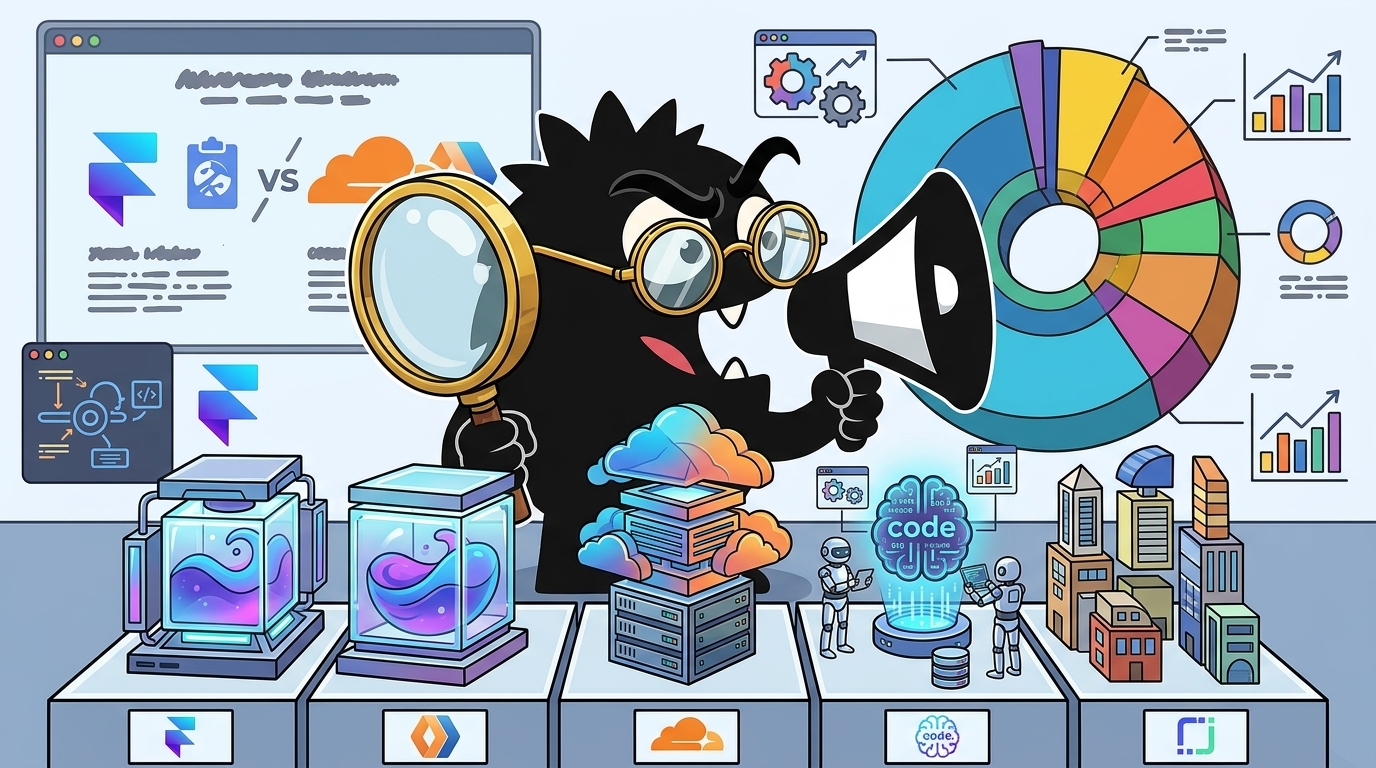
Enterprise teams comparing Framer, Render, and Cloudflare Workers are often asking the wrong first question. This is not a clean three-way fight for the same budget line. It is a decision about which parts of your software estate you want to optimize for speed, control, global performance, or non-engineer autonomy.
In practice, these platforms sit in different layers of the stack:
- Framer is a website platform for design-led publishing and marketing surfaces, with enterprise features around hosting, security, and collaboration.[1]
- Render is a cloud application platform for deploying web services, background workers, databases, static sites, and Docker-based workloads without forcing teams into raw-cloud complexity.[7]
- Cloudflare Workers is an edge runtime for code that executes close to users, useful for request handling, personalization, routing, APIs, and distributed application logic.[13]
That distinction matters because enterprise software teams rarely have just one problem. They have a marketing site, product UI, APIs, auth flows, internal tools, and governance requirements. The live X conversation gets this better than many product comparison pages do. People keep recommending combinations, not single-platform purity.
For frontend ofc Cloudfare and for deploying python backend, ofc Render
Cloudfare + Render or Vercel + Render combos are best and probably better than AWS
That pattern shows up because teams are really choosing an operating model. Do you want marketing to ship without filing engineering tickets? Do you want backend engineers to deploy Python or Docker apps in minutes? Do you want frontend traffic handled at the edge with low latency and programmable routing? Those are different goals.
Tech stack 2024
- Frontend: @remix_run
- Backend: @FastAPI
- Compute: @render
- Vector DB: @qdrant_engine
- RDB: @PostgreSQL
- Storage: @Cloudflare R2
- ORM: @DrizzleORM
- Email: @MailerSend
- UI: @shadcn / @tailwindui / @daisyui_ / @framer / @SocketIO
Can't be better!
Even the “depends on the use case” framing, repeated across the discussion, is more useful than vendor-vs-vendor scorecards.
Depends on the use case.
Vercel for frontend and Next.js, zero config and best DX in the category.
Cloudflare Workers for edge functions and global low-latency at near-zero cost.
Render when you want Heroku simplicity without the Heroku price.
AWS when you need the full ecosystem, compliance requirements, or serious scale.
For enterprise teams in 2026, the real comparison is not “which platform wins overall?” It’s which platform is best for which job, and where does standardization create more friction than leverage?
Developer Experience and Learning Curve: Fastest Path to Shipping
If your mandate is to get teams productive fast, these three platforms create very different onboarding experiences.
Render has the clearest value proposition for backend teams: it removes the ceremony. The attraction is not just lower cost; it is lower cognitive overhead. Render packages the infrastructure features teams need—deployments, autoscaling, previews, networking, logs—into a workflow that feels closer to “ship the app” than “assemble the cloud.” Its pricing and platform positioning are explicit about serving app teams rather than forcing customers to stitch together primitives.[7][12]
If you're starting a SaaS, speed up dev time with @render.
It takes 10 minutes (for anyone) to setup:
- auto-scaling
- github CI/CD
- health checks
- load balancing
- ddos protection
- custom domains
- internal networking
- pull request previews
- datadog logs streaming
I've been using Azure for almost 4 years, but if starting over I'd use Render from day one.
Can you imagine how long would this take with Azure, AWS or GCP...?
That sentiment keeps recurring because enterprise teams often don’t need infinite flexibility. They need a safe default that lets a small team run production services without hiring a platform engineering group on day one.
Pallyy's (almost $1M ARR) backend costs $85/mo to run on @render.
Here's why I've just moved everything from Azure to Render.
*even though I've got $25K azure credits
➜ Zero learning curve
Just recently I've hired my first employee, a developer. They weren't familiar with Azure so the learning process has been pretty steep.
A process (deploying a docker to container then to an app service) that took us 2-3 days in Azure, literally took 10 minutes in Render.
Render's UI is so simple it makes it so easy to learn how to use it, anyone can do it.
➜ Great UI
Their UI is fast, you can move between pages at lightning speed.
Compare this with azure (which is super slow) and it's an absolute dream.
➜ Better features for small start-ups
Azure has everything yes, but it's in-depth. To get one system running you might need to deploy 4-5 services.
With Render, the features are geared towards people like us. You can just deploy one service, and it has basically everything you need.
➜ More affordable
Render is actually much cheaper than Azure, because when you're using Azure it's most likely overkill as they have a lot of features.
Pallyy's main server costs $85/mo compared to about $150+ in Azure.
➜
I'm not affiliated with Render, but if you're just starting out I'd say 100% go with Render.
Framer is fast in a different way. It shortens the path for design, brand, and marketing teams to ship production web experiences without waiting on frontend engineers for every layout or content iteration. For companies where web publishing is slowed by code handoffs, Framer’s learning curve is often the feature. Its enterprise offering is explicitly aimed at teams that “move fast,” and its support materials emphasize organizational workflows and admin needs.[1][4]
As a designer and developer also:
- You own the codebase and decide where to host it
- You have vastly greater control when working with code directly
- Optimizing for speed and lighthouse is way quicker
If you are arguing for Framer, far better argument in my opinion would be:
- The way Framer treats creators, which is incredible
- Differnet income stream options with Framer
- Far lower learning curve compared to Webflow
That's why I say, if you don't want to go down the AI route, Framer is the best alternative option. At this point Framer is superior tool to Webflow.
That last point matters for enterprise leaders: DX is role-specific. A designer who needs to launch a campaign page, a backend engineer deploying a FastAPI service, and a platform architect designing a globally distributed edge layer are not evaluating “ease of use” in the same way.
Cloudflare Workers is where the tradeoff becomes sharpest. Workers offers speed and power, but many developers accurately describe it as requiring a new architectural mental model. You’re not just learning a dashboard. You’re learning a different runtime environment, deployment pattern, and often a different way of thinking about state, latency, and composition.
Can someone explain to me why @Cloudflare went for this workers approach? To me it feels like it worsens the developer experience
And a lot of other limitations. It's like you have to develop a new mental model of how you architect your software
That does not mean Workers has poor DX. It means its DX is excellent for teams that want edge-native software, and more demanding for teams expecting a conventional long-running server. For enterprise buyers, that difference is critical. Faster to deploy is not the same as faster to adopt.
For Frontend and Marketing Surfaces: Framer vs Workers
When teams compare Framer and Workers for frontend work, they are usually comparing visual publishing against programmable delivery.
Framer is strongest when the business need is straightforward: ship a polished, fast-moving website with heavy design and marketing involvement. Enterprise teams use these surfaces for product launches, campaign pages, documentation-adjacent marketing, recruiting, and brand storytelling. Framer’s enterprise positioning centers on team collaboration, premium hosting, and scalable infrastructure for sites that need to look excellent and change frequently.[1][2]
3 things I noticed from these Framer builds hitting my timeline:
1. That mortgage platform comparison — the "experiencing it in Framer hits differently" comment is spot on. The visual editor gives you spatial context that static mockups can't.
2. Day 3/30 intro animation shows how Framer's timeline makes complex sequences feel approachable. No keyframe hell.
3. These hero section posts prove the community gets it — Framer isn't just for prototyping anymore. It's where you ship the real thing.
#framer
The reason Framer has gained credibility is simple: it has crossed the line from “prototype tool” to “real production website platform” in the minds of many practitioners. That is especially relevant inside enterprises where marketing organizations are tired of waiting in the software delivery queue behind roadmap work.
But Framer’s accessibility comes with a tradeoff. If your primary concern is code-level control, custom routing, edge auth, highly dynamic request handling, or integrating frontend delivery tightly with application logic, Workers is the more capable fit. Cloudflare Workers lets teams run code close to users across Cloudflare’s network and pair it with platform services for richer distributed architectures.[13]
They did it: Static assets. With regular workers projects. Which means access to all the other cloudflare services, no compromises.
You should build your next website/app/idea on Workers.
This is why the Framer-vs-Workers choice is really a question about the main bottleneck:
- If the bottleneck is design velocity and publishing autonomy, Framer wins.
- If the bottleneck is application behavior at the network edge, Workers wins.
Vercel for frontend projects because the developer experience is unmatched. AWS when you need full control and scale. Cloudflare is seriously underrated for edge deployments. Render is perfect for backend side projects without the AWS complexity.
View on X →For enterprise software teams, that distinction usually maps to ownership. Marketing and brand organizations benefit from Framer because they can own the site. Product engineering organizations benefit from Workers when they want frontend delivery to be part of the application architecture, not a separate publishing workflow.
For Backend Services and Internal Apps: Why Render Keeps Winning the Simplicity Argument
Among these three platforms, Render is the closest thing to an obvious backend default for teams that want modern app hosting without AWS-level operational overhead.
Render supports the common deployment patterns enterprise teams actually use: web services, cron jobs, background workers, static sites, managed Postgres, private networking, and Docker deployments.[7][12] That matters because most internal apps and line-of-business systems are not exotic edge-native systems. They are conventional services that need to be deployed reliably, observed, and governed by a reasonably small team.
Render for backend and cloudfare for frontend
View on X →The platform’s strongest argument is not novelty. It is removing unnecessary cloud ceremony. Teams repeatedly frame Render as the place to go when they want to avoid the complexity tax of Azure, AWS, or GCP for standard backend workloads.
vercel for next.js stuff because the DX is unbeatable. render for everything else. aws if you enjoy reading docs more than shipping. cloudflare workers if you want to feel smart at parties
View on X →That’s especially true for Python, Node, Go, and Docker-based services where the enterprise does not want to spend weeks building CI/CD, autoscaling, and networking patterns from lower-level infrastructure. Render’s product packaging is essentially a bet that many teams would rather consume a well-integrated application platform than build their own internal Heroku replacement.[7]
For backend and internal tools, Render often hits the sweet spot because it gives teams:
- faster onboarding for new engineers,
- predictable deployment workflows,
- managed operational features,
- and a lower chance that small product teams become accidental infrastructure teams.
This is why it keeps winning the simplicity argument. It does not promise maximum control. It promises that shipping the app stays the main job.
Cloudflare Workers: Edge Performance, Microfrontends, and the Cost of a New Mental Model
Where Render optimizes for application simplicity, Cloudflare Workers optimizes for distribution.
Workers is compelling when your architecture benefits from running logic close to users: low-latency APIs, edge auth, request shaping, geo-aware behavior, personalization, bot filtering, A/B routing, static asset delivery, or frontend composition. Cloudflare’s docs position Workers as a serverless execution environment integrated with the rest of Cloudflare’s network and developer platform.[13]
The excitement around Workers has become more concrete because the platform now supports patterns that used to feel awkward or incomplete for larger apps.
Microfrontend support in Cloudflare was my weekend project. Put many workers under a single domain with zero changes to your projects.
One domain, many paths, mapped to separate Workers.
/ = Marketing
/docs = Docs
/dash = Dashboard
That post captures something important for enterprise teams: Workers is no longer just “tiny edge functions.” It is increasingly viable for multi-surface applications, where marketing, docs, dashboard, and API layers can be composed under one domain with different routing and execution strategies.
Following up on my earlier “Deploy + AI Co‑Pilot” idea for the Deploy to Cloudflare button 👇
I put together 3 real‑world but minimal templates that break the “happy path” a bit and exercise different parts of the flow:
1️⃣ D1 + KV + edge caching
cf-workers-d1-kv-rate-limit-api
👉 https://t.co/HgWd0gNKPE
2️⃣ Multi‑Worker monorepo w/ shared bindings
cf-workers-monorepo-shared-bindings
👉 https://t.co/V9nFTzmSZ3
3️⃣ Workers AI + Durable Objects + D1 chat
cf-workers-ai-do-chat
👉 https://t.co/8eZ0J3e9gM
This is also where Workers becomes attractive for platform teams. Monorepos, shared bindings, Durable Objects, D1, KV, and static assets make the platform more composable than many developers assume at first glance. Cloudflare’s own best-practices guidance reflects that enterprise customers are now shipping real production systems on Workers, not experiments.[13]
we've just published a new @cloudflare Workers best practices guide to the docs: https://developers.cloudflare.com/workers/best-practices/workers-best-practices/
based on guidance we give customers + our own teams every day when shipping Workers to prod.
you can also install it as an agent skill: > npx skills add cloudflare/skills
But the criticism from X is also right: the power comes with an architectural price. Workers asks teams to think in terms of stateless request handling, edge placement, runtime constraints, distributed state strategies, and service composition. If your current engineering culture is built around centralized app servers and familiar PaaS assumptions, Workers will feel like friction before it feels like leverage.
cloudflare grabbing the framework authors is how workers becomes the default deploy target
View on X →So the enterprise question is not “is Workers powerful?” It is. The question is whether your application actually benefits enough from edge-native design to justify the shift in mental model. If the answer is yes, Workers can be transformative. If not, it can be an expensive detour in engineering attention.
Security, Governance, and Compliance: What Enterprise Buyers Need to Validate
This is the part of the comparison that X often gestures toward but doesn’t fully unpack: enterprise adoption is rarely blocked by deployment mechanics alone. It is blocked by governance.
For Framer, the enterprise pitch is not just better publishing. It is managed website operations with organizational controls, premium infrastructure, and enterprise support.[1][2] If the governed asset is your public website, buyer concerns will center on admin controls, uptime expectations, support responsiveness, domain management, and whether non-engineers can safely operate the system.
For Render, the enterprise story is more explicit around security and platform administration. Render documents security and trust posture, organizational management, plan-based feature access, and HIPAA support for eligible workloads.[8][10][9][11] That means enterprise teams can evaluate concrete controls such as:
- SSO
- role-based access and workspace governance
- auditability and organization management
- compliance alignment for regulated workloads
- support and administrative separation
For many buyers, those requirements become the real decision boundary. A startup can choose on DX alone. A large enterprise usually cannot.
What’s the best place to deploy side projects right now? 👀
▲ Vercel
☁️ Cloudflare
🚀 Render
🟠 AWS
One is beginner-friendly.
One is insanely fast.
One is enterprise chaos.
One makes you feel like a DevOps engineer overnight
For Cloudflare Workers, governance evaluation tends to be tied to the broader Cloudflare relationship: network security posture, identity controls, observability, deployment governance, and how the edge runtime fits existing compliance workflows. Even when the technical team loves the platform, procurement will still ask who can deploy what, how incidents are audited, where data lives, and what support path exists.
The practical takeaway: the “best” platform depends on what you are governing.
- A marketing site has one governance profile.
- A backend handling customer data has another.
- An edge runtime shaping traffic globally has a third.
Enterprises should treat these as separate control domains, even if the same engineering org influences all three.
Pricing and Total Cost of Ownership: Cheap to Start, Expensive to Misjudge
Public pricing signals only tell part of the story.
Framer offers standard pricing tiers, but enterprise deals are generally custom, and the economic value often comes from reducing engineering dependency for web publishing rather than from raw infrastructure savings.[3][5] If marketing can launch and iterate without constant frontend support, Framer may be “expensive” on paper and still highly efficient in practice.
Render is easier to reason about because its pricing is visibly structured across plans, with higher tiers unlocking the kinds of governance and compliance features enterprises often need.[7][11] It is frequently described as the affordability play because teams can get platform features without paying the hidden tax of operating raw cloud.
Depends on the use case.
Vercel for frontend and Next.js, zero config and best DX in the category.
Cloudflare Workers for edge functions and global low-latency at near-zero cost.
Render when you want Heroku simplicity without the Heroku price.
AWS when you need the full ecosystem, compliance requirements, or serious scale.
Most indie devs start on Vercel, hit limits, and graduate to AWS. Cloudflare is increasingly the sleeper pick for AI-native apps that need edge inference.
Cloudflare Workers can look incredibly cheap for edge execution, especially in workloads where request handling is lightweight and globally distributed. Cloudflare’s Workers docs and pricing emphasize that the model is built for scalable edge compute rather than traditional server leasing.[13][14] But enterprise TCO is not just the bill. It includes:
- architectural retraining,
- migration effort,
- developer productivity during the learning curve,
- observability and governance overhead,
- and the opportunity cost of choosing the wrong runtime model.
That last point is where many comparisons go wrong. A platform can be low-cost and still be high-TCO if your team spends six months adapting patterns it did not need.
Dev Setup 2024
- No staging servers (only previews)
- No unit tests (except regex corner cases)
- No E2E tests (except payment walkthrough)
- Instead, @posthog / @getsentry for insights
- Looking forward to @vite_js @rolldown_rs coming to @remix_run
Unlearn your standards!
The most mature way to price these platforms is to ask four questions:
- Who gets unblocked?
- What operations work disappears?
- What new complexity is introduced?
- What risk is reduced through better defaults, support, or governance?
Base price matters. But in enterprise software, staffing and execution drag usually matter more.
Who Should Use What? Recommended Patterns for Enterprise Software Teams
There is no single winner here, because these platforms are strongest in different domains.
Use Framer when your priority is empowering design and marketing teams to ship high-quality web experiences with enterprise controls and support.[1]
Use Render when your priority is backend simplicity, conventional app hosting, Docker or Python deployment, and reducing cloud operations burden.[7]
Use Cloudflare Workers when your priority is edge performance, global request handling, distributed frontend composition, or programmable routing close to users.[13]
And for many enterprises, the best architecture is the one the X conversation keeps converging on: a composable stack.
- Framer for the brand and campaign site
- Render for APIs, internal apps, and core backend services
- Workers for edge auth, routing, caching, personalization, and global performance layers
After joining Cloudflare we introduced a new component library internal to the company – Kumo.
This new Workers landing page uses that component library (and many other Developer Platform products). But most of the credit here goes to @nandafyi for literally COOKING 🧑🍳
That model is not architectural indecision. It is often the most rational allocation of tools to jobs.
If you are a CIO or platform leader trying to standardize everything onto one platform, the right question is not “can we?” It is “what do we lose by forcing one operating model on teams with very different needs?”
In 2026, the strongest enterprise teams will not pick one of Framer, Render, or Cloudflare Workers as a universal winner. They will use each deliberately, where its strengths compound.
Sources
[1] Framer Enterprise: Built for teams who think big and move fast — https://www.framer.com/enterprise/
[2] Framer Enterprise: Secure infrastructure built to scale — https://www.framer.com/enterprise/infrastructure/
[3] Framer: Pricing — https://www.framer.com/pricing
[4] Framer Help: Enterprise — https://www.framer.com/help/enterprise/
[5] Framer Blog: Simplified pricing — https://www.framer.com/blog/pricing-update/
[7] Pricing — https://render.com/pricing
[8] Security and Trust — https://render.com/security
[9] HIPAA on Render — https://render.com/docs/hipaa-compliance
[10] Organizations – Render Docs — https://render.com/docs/organizations
[11] Platform Features by Plan — https://render.com/docs/platform-features-by-plan
[12] Render | The cloud for builders — https://render.com/
[13] Overview · Cloudflare Workers docs — https://developers.cloudflare.com/workers/
[14] Pricing · Cloudflare Workers docs — https://developers.cloudflare.com/workers/platform/pricing/
References (15 sources)
- Framer Enterprise: Built for teams who think big and move fast - framer.com
- Framer Enterprise: Secure infrastructure built to scale - framer.com
- Framer: Pricing - framer.com
- Framer Help: Enterprise - framer.com
- Framer Blog: Simplified pricing - framer.com
- Framer Enterprise features, limits, and pricing explained - brixtemplates.com
- Pricing - render.com
- Security and Trust - render.com
- HIPAA on Render - render.com
- Organizations – Render Docs - render.com
- Platform Features by Plan - render.com
- Render | The cloud for builders - render.com
- Overview · Cloudflare Workers docs - developers.cloudflare.com
- Pricing · Cloudflare Workers docs - developers.cloudflare.com
- Customer Case Studies - cloudflare.com
Related Guides

Perplexity AI vs Meta Llama: Which Is Best for Data Analysis and Reporting in 2026?
19 min read
Notion vs Webflow: Which Is Best for AI Pair Programming in 2026?
15 min read
What Is Vercel? A Complete Guide for 2026
18 min read
What Is Supabase? A Complete Guide for 2026
18 min read