Dify vs LlamaIndex vs Botpress: Which Is Best for Data Analysis and Reporting in 2026?Updated: June 14, 2026
Dify vs LlamaIndex vs Botpress for data analysis and reporting: compare workflows, RAG, analytics, pricing, and fit by team. Discover
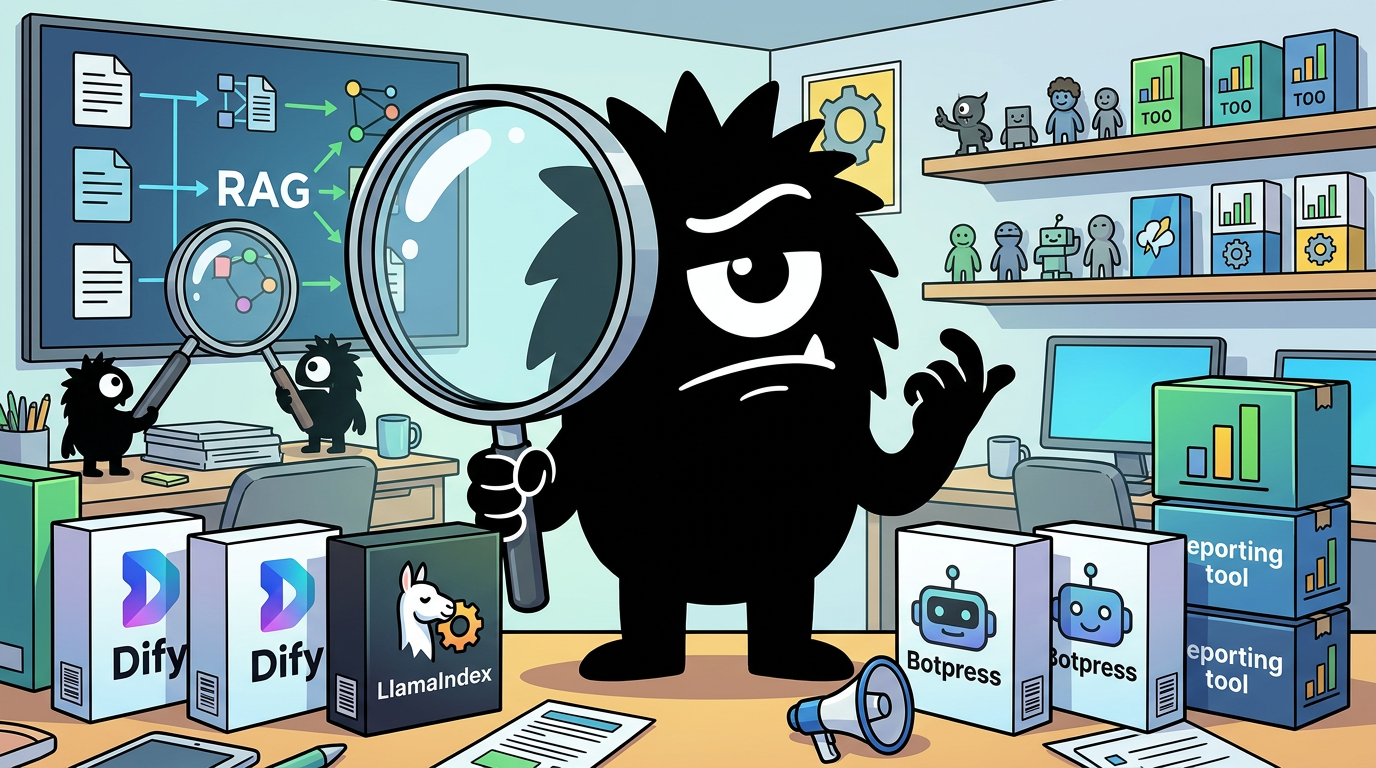
Start With the Job: What Kind of Data Analysis and Reporting Are You Actually Building?
“Data analysis and reporting” sounds like one category, but in practice it’s at least three different jobs:
- Conversational reporting: a user asks questions in chat and gets metrics, summaries, or next-step recommendations.
- Document-grounded analysis: the system reads PDFs, spreadsheets, reports, or knowledge bases and synthesizes answers.
- Agentic research and report generation: the system plans, searches, extracts, compares sources, then writes a structured output.
That distinction matters because Dify, LlamaIndex, and Botpress were built from different starting points. Dify is an app-building and workflow platform for LLM applications with built-in knowledge, orchestration, and deployment features.[2] LlamaIndex is a developer framework for connecting LLMs to data and building retrieval, agent, and workflow systems.[1] Botpress is a conversational AI platform optimized around bots, interaction flows, integrations, and operational deployment.[3]
The X conversation is already much more concrete than most comparison pages. Teams are not asking “Which AI platform is best?” They’re asking which tool helps them build quality inspection reports, deep research assistants, financial analysis systems, or chat interfaces with usable analytics.
社内のMLチームにDify vs CrewAI vs LangChainを比較検証させた。
用途:製造業の品質検査レポート自動生成
結果:
Dify→ノーコードで最速。ただしカスタマイズに限界
CrewAI→マルチエージェントに強い。学習コスト高
LangChain→自由度最高。だがエンジニアリソース必須
結論:最初はDifyで始めて、限界が見えたらLangChainに移行するのが最適解。
自社の用途に合うツール選定、無料でお手伝いしています。DM開放中。
That post gets the framing right: tool choice follows workload. If your reporting job is “generate a manufacturing quality report from known inputs,” the fastest no-code path may be enough. If it’s “search across messy 10-Ks, extract tables, compare entities, and produce a structured narrative,” you are in a different class of problem.
The same goes for the front end. Some teams don’t need a report generator as much as a report delivery surface with user analytics and operational controls. That’s where Botpress enters the conversation.
Which layer would save YOUR team the most time?
🎨 Flow 🧠 NLU ⚡ Actions
📚 Knowledge 📊 Analytics
Free Botpress Agent Dev System:
https://whop.com/unfurl/dashboard/biz_r7LQt6PtS7NcKY/products/prod_Wwtj0KZLUv9rf/
#Botpress #ConversationalAI #Chatbots #AIAgents #CustomerSupport #BuildInPublic
So here’s the thesis: Dify is strongest when speed to a usable reporting app matters most. LlamaIndex is strongest when retrieval depth and document intelligence matter most. Botpress is strongest when reporting needs to be delivered through a conversational product with measurable user behavior.
Dify Wins the Fastest Path to a Working Reporting App—Until You Need More Control
Dify’s appeal is simple: it removes a huge amount of assembly work. Its docs position it as an open-source LLM app development platform with workflow orchestration, RAG, model management, observability, and deployment paths built in.[2] For teams that want to automate reporting without building a custom backend, that matters immediately.
DROP EVERYTHING.
This GitHub repo just hit 136K stars and it’s the fastest way to ship an AI app:
Dify helps you go from prototype to production without writing 1,000+ lines of glue code and using 6 other tools.
Here’s what it handles for you:
1. RAG pipelines:
Built-in hybrid search (BM25 + vector), chunking, and support for PDFs, Notion, DOCX, web scraping.
2. Agent orchestration:
Visually build ReAct-style workflows using tools, API calls, and logic blocks - no manual loops in Python.
3. Model routing:
Easily switch between GPT, Claude, or local models like Llama via Ollama/vLLM.
4. Auto-generated APIs:
Every saved workflow gets an auto-generated REST endpoint, ready to integrate.
5. LLMOps & monitoring:
Full tracing, latency, token usage, and annotation support - ready for production.
No more stitching together LangChain, FastAPI, vector DBs, and monitoring tools. Think of Dify as the missing infrastructure layer between your AI logic and a real product.
You can self-host it or use their cloud. 100% free to start.
That post is enthusiastic, but directionally accurate. Dify gives teams a visual workflow builder, knowledge ingestion, prompt management, API publication, and model switching in one system.[2] For internal reporting apps, that can cut weeks of glue code.
Why does that matter for data analysis? Because many real reporting workflows are not “hard AI” problems. They are operational packaging problems:
- Ingest a PDF or Notion page
- Retrieve relevant sections
- Run extraction or summarization
- Apply business logic
- Return a narrative or structured output
- Expose it through an internal app or API
Dify is well suited to exactly this kind of pipeline. Non-ML teams like operations, support engineering, revops, and internal tooling groups can ship useful systems without owning the full stack.
🚨BREAKING: OpenAI Assistants API costs money per token.
Lang Smith is paid after free tier.
Most LLM Ops platforms charge $99+/month.
There is a free open-source alternative.
129,000+ stars on GitHub.
It is called Dify.
You build production AI apps from a visual dashboard.
Chatbots. Agents. RAG pipelines.
No ML degree required.
What you get for $0:
Visual workflow builder for AI agents
Built-in RAG connect your own documents
Prompt management + A/B testing
Auto-generated API endpoint Deploy on your own server
One engineer. One weekend.
One production AI app.
No vendor lock-in. Your data stays yours.
Self-hosted. Free forever.
100% Open Source.
The no-code/low-code appeal is real, especially when self-hosting and avoiding a growing pile of paid LLMOps tools. But the tradeoff is just as real: Dify is opinionated software. That is its strength and its ceiling.
Once you need highly customized retrieval logic, unusual parsing strategies, bespoke ranking, complex agent state handling, or deep integration into an existing engineering platform, the abstraction starts to pinch. Dify has expanded its workflow and extensibility model significantly, including code execution nodes and a declarative workflow representation,[9][8] but it still serves best as a platform, not as an unrestricted programming framework.
🎉Dify 进入新篇章!🚀AI Workflow 同时登录云服务和开源社区版。现在,你可以基于众多模态模型构建复杂的 LLM 应用了。
在此次更新了超过 100,000 行代码的重大版本中,我们给全球开发者带来了:
1️⃣“这很 Dify”的全新 LLM 流程编排,我们打造了迄今为止最佳的应用开发体验。你可以基于 Dify 构建 Agentic Workflow,以独立应用或 API 的方式交互。
2️⃣在节点上进行可视化调试,所见即所得的进行 Workflow 编排,便于迅速定位问题和得到正确的输出预期。
3️⃣可插拔的 DSL,完全声明式的 Workflow 定义使你的应用编排可以自由地在开源社区或团队中分享。
4️⃣原生的代码运行时,支持 Python 和 JS 代码作为节点编排到应用步骤中。
5️⃣由原厂和社区开发者提供的超过几十种 Tools,可双向兼容 Workflow 和 Agent 应用。当然…你可以接上你自己的。
Dify 作为 LLM 中间件的“创新队长”,以体验、工程、开源为社区持续注入活力。🌟凭借我们在多模型、多模态、Agent 和 RAG 上的工程积累,已经成为众多 500 强企业和创新者的坚定选择📈。
身为品类标杆,Dify 有持续定义新标准的责任。期待与你们一同探索 GenAI 的能力边界🚀!
👉去 GitHub 中了解 Dify v0.6 https://t.co/ky5S23VsuA
👉访问 Dify 云服务 https://t.co/3jyib3UObm
#Dify #LLM #LLMOps #Agnet
That update is important because it shows Dify moving closer to developers, not just no-code users. Visual debugging, code nodes, tools, and shareable workflow definitions make it more production-capable than early low-code AI builders. Even so, the practical rule still holds: use Dify when speed, standardization, and lower operational overhead matter more than total architectural freedom.
For internal reporting automation, that’s often the right answer. For document-heavy intelligence systems, maybe not.
LlamaIndex Has the Edge When Reporting Depends on Complex Documents, Multi-Doc Retrieval, and Structured Extraction
LlamaIndex is a different beast. It is not primarily a visual builder; it is a framework for ingesting, structuring, indexing, retrieving, and orchestrating over data for LLM applications.[1] If Dify helps you stand up an app fast, LlamaIndex helps you engineer the data layer that serious reporting systems depend on.
That matters most when reporting is grounded in many documents, complex layouts, or structured extraction requirements. The X conversation around LlamaIndex consistently centers on exactly those problems.
Head-to-head 🥊: LlamaIndex vs. OpenAI Assistants API
This is a fantastic in-depth analysis by @tonicfakedata comparing the RAG performance of the OpenAI Assistants API vs. LlamaIndex. tl;dr @llama_index is currently a lot faster (and better at multi-docs) 🔥
Some high-level takeaways:
📑 Multi-doc performance: The Assistants API does terribly over multiple documents. LlamaIndex is much better here.
📄 Single-doc performance: The Assistants API does much better when docs are consolidated into a *single* document. It edges out LlamaIndex here.
⚡️ Speed: “The run time was only seven minutes for the five documents compared with almost an hour for OpenAI’s system using the same setup.”
🛠️ Reliability: “The LlamaIndex system was dramatically less prone to crashing compared with OpenAI's system”
Check out the full article below:
Multi-document retrieval is where many “it worked in the demo” systems fall apart. A single cleaned document is easy. A reporting corpus with multiple PDFs, inconsistent sections, embedded tables, appendices, and contradictory evidence is not. LlamaIndex has earned mindshare because it focuses on these retrieval and indexing challenges instead of hiding them.
Its ecosystem now spans ingestion pipelines, parsers, retrieval components, workflows, agents, and managed services.[1] In practical terms, that means developers can tune chunking strategies, metadata, query routing, reranking, extraction patterns, and synthesis behavior in ways low-code platforms often abstract away.
Building scalable, distributed document processing pipelines isn’t easy.
That’s why we teamed up with @render to build a system that:
📝 Leverages the LlamaParse platform to parse, classify, extract, and retrieve information from documents
⚙️ Uses Render Workflows to distribute tasks across nodes and accelerate background processing
⚡ Deploys a lightweight server and database on Render, giving you an instant interface to interact with your pipeline
👩💻 Explore the repo to see it in action: https://t.co/eiJqklNVhj
📚 And check out the step-by-step breakdown by @ojusave and @itsclelia:
That’s not a minor advantage. In enterprise reporting, parsing is often the system. If your source documents are financial reports, inspection documents, contracts, research papers, or compliance PDFs, bad parsing creates bad retrieval, which creates bad analysis. LlamaIndex’s push into document processing and services like LlamaParse and managed ingestion is aimed directly at this bottleneck.[1]
The financial reporting use case is especially revealing. A recent example of building a financial report retrieval system with LlamaIndex emphasizes retrieval over annual reports and structured querying over financial data.[6] LlamaIndex’s own reporting examples lean hard into chunk-level and document-level context retrieval from complex financial documents.[9]
Multi-agent workflow to Generate a Structured Financial Report 📊
In our new video we show you how to generate simple analyses containing text and tables over a bank of 10K documents.
First, we use LlamaCloud to advanced retrieval endpoints allowing you to fetch chunk and document-level context from complex financial reports consisting of text, tables, and sometimes images/diagrams.
We then build an agentic workflow on top of LlamaCloud, using OpenAI GPT-4o, consisting of researcher and writer steps in order to generate the final response.
Video: https://t.co/njMOgcxuif
Signup to LlamaCloud: https://t.co/yQGTiRSNvj
For enterprise usage, come talk to us:
That workflow—researcher plus writer over a bank of 10-Ks—is exactly the kind of reporting problem where code-first architecture wins. You usually need:
- Advanced parsing for tables and semi-structured sections
- Retrieval over multiple related documents
- Context assembly at more than one level
- Explicit report structure
- Evaluation and observability around each stage
You can approximate some of this in low-code tools. But if this is your core product or a mission-critical internal capability, LlamaIndex gives you more control over the parts that actually determine output quality.
That comes with a cost: higher implementation complexity. Your team will need engineers comfortable with retrieval systems, APIs, orchestration, and debugging distributed pipelines. But if your reporting accuracy depends on document intelligence, LlamaIndex is usually the strongest foundation of the three.
Botpress Is Strongest When Reporting Needs a Conversational Front End and Built-In User Analytics
Botpress should not be judged as a pure RAG framework because that is not its center of gravity. Botpress is a platform for building conversational AI systems with flows, knowledge, actions, integrations, and bot management.[3] If your reporting experience is going to live inside a chatbot, assistant, intake flow, or stakeholder-facing conversational product, Botpress becomes much more compelling.
From "Empty Variable" to Enterprise Pipeline.
Just finished a high-ticket intake system for all business owners
The Stack: 🧠 @Botpress (NLU & Intent Routing) @Make_hq (Middleware & Logic) 📊 @NotionHQ (Internal Ops Dashboard
Watch part1:
#BuildInPublic #AIAutomation #NoCode
That post shows the pattern clearly: Botpress handles NLU and routing, while surrounding tools handle middleware and dashboards. In other words, Botpress often sits at the interaction layer of a reporting system. It is where users ask for status, submit requests, refine scope, or receive outputs.
This is a different value proposition from LlamaIndex. Botpress is about making the report experience usable and operational. That includes conversation design, actions, integrations, and importantly, analytics. Botpress has put real emphasis on chatbot analytics as a product category, including metrics for understanding user behavior and improving bot performance.[12]
Improve your business with custom chatbot metrics.
Here’s how chatbot analytics help you understand what users actually ask for. 👀
That matters more than many teams realize. A reporting assistant that generates decent answers but gives you no visibility into what users ask, where they drop off, or which workflows fail is hard to improve. Botpress is stronger than the other two when your success metric includes:
- User engagement
- Containment or resolution rates
- Step completion in intake/reporting flows
- Popular intents and missed questions
- Operational handoff points
For internal assistants, customer-facing reporting bots, or operational systems where people converse their way into an analysis request, that’s a meaningful advantage. Botpress’s own docs and ecosystem position it squarely in the low-code conversational AI category rather than the deep retrieval framework category.[3][7]
The limitation is straightforward: Botpress is not the best choice if your hardest problem is document retrieval depth. It can consume knowledge and connect to external systems, but if the analysis depends on advanced indexing, extraction, and multi-document synthesis, Botpress is usually better as the front end than the engine.
Agentic Research Workflows Are Becoming the New Reporting Stack
The most interesting shift in the market is that reporting is becoming less like “ask one prompt, get one answer” and more like research orchestration. Systems now decompose a question, search iteratively, evaluate findings, extract structured evidence, and only then write the result.
Dify has leaned into this pattern through visual agentic workflows.
🔍 DeepResearch: Automating Research with Dify Agentic Workflow
Say goodbye to research drudgery! Learn how DeepResearch, built with a Dify agentic workflow, automates multi-step searches & summarization.
✨ How It Works:
- Iteration node loops through search rounds.
- LLM nodes suggest keywords and determining when to stop.
- Other nodes: LLM, Search/Extraction, Assigner, IF-ELSE, Answer.
Focus on insights, not repetition. Big thanks to @omluc_ai for this guide!🙌
Read the full article: https://t.co/3BwJcrGSpm
#Dify #LLM #DeepResearch #AgenticWorkflow
That visual iteration model is useful for teams that want deep-research behavior without implementing orchestration loops from scratch. For analysts and product teams, it makes the logic inspectable: search rounds, stop conditions, branch logic, answer synthesis. This is one of Dify’s strongest counters to the claim that low-code platforms can only handle simple chatbot demos.
But LlamaIndex goes deeper here because the workflow is code-first and composable. Its workflow primitives, agent support, and data handling make it a better fit when research steps need custom logic, external retrieval policies, or long-running stateful execution.[1]
LlamaResearcher - deep research with Llama4 🦙🧑🔬
Excited to feature a fully open-source project by Clelia Bertelli that is a complete deep research solution built with Llama4, @GroqInc , Linkup, @FastAPI, @Redisinc , @Gradio, and of course, @llama_index.
The workflow is simple:
💬 Submit a query
🛡️ Evaluate the query by the Llama 3 guard model, which deems it safe or unsafe
🧠 If safe, route to the Researcher Agent
⚙️ The Researcher Agent expands the query into three sub-queries to do web search
🌐 search web for each of the sub-queries
📊 Evaluate retrieved info for relevancy against your original query
✍️ Produce an essay based on the information it gathered, paying attention to referencing its sources
Page: https://t.co/QyHBFxZysL
Repo: https://t.co/p2xqlOS0vW
If you’re interested in building your own deep research agents on top of @llama_index, check out our page:
That researcher-agent pattern—expand into sub-queries, search, evaluate relevance, synthesize with references—is rapidly becoming the baseline for serious report generation. And LlamaIndex’s architecture is simply more natural for it.
The same applies to longer-running document workflows with state, resumability, and instrumentation.
This open-source NotebookLM alternative demonstrates a complete architecture for document-powered AI apps:
🏗️ Event-driven workflows orchestrate complex multi-step processes like document parsing, summary generation, and podcast creation
☁️ LlamaCloud handles the heavy lifting with automated document ingestion pipelines and structured data extraction
🔄 State management allows workflows to save progress and resume later, perfect for long-running document processing tasks
📊 Built-in observability with @opentelemetry integration gives you insights into every step of your workflow execution
The project integrates LlamaExtract for transforming documents into an initial notebook with a mind map, FAQs, summaries, and services like @elevenlabs for text-to-speech generation.
Explore the complete NotebookLlaMa implementation:
This is the practical distinction: Dify makes agentic reporting accessible; LlamaIndex makes it deeply engineerable. Botpress can absolutely participate in these workflows, but usually as the user-facing shell: collecting the prompt, showing progress, asking follow-ups, and presenting results. It is rarely the deepest research engine in the stack.
If your roadmap includes “deep research,” “automated report drafting,” or “multi-step evidence synthesis,” you should assume orchestration quality will matter as much as model quality.
Cost, Usage Visibility, and Observability: The Practical Debate Under the Hype
One reason Dify keeps coming up on X is not just app speed. It’s operational visibility. When teams first launch reporting apps, token spend often looks trivial—until usage grows, documents get longer, and workflows chain together multiple calls.
token costs sneak up fast when you're not watching per-call spend across 50 daily users. Dify's usage dashboard catching that before your bill does is what I need, early warnings
View on X →That is a real production concern. Dify includes usage and monitoring capabilities in its platform story, covering logs, tracing, and token-related operational views.[2] For teams without a mature AI platform function, getting that visibility out of the box is a major benefit.
Botpress brings a different observability angle: user analytics. If the key question is “what are people asking and how are they moving through the bot?”, Botpress has stronger native product analytics framing, especially around chatbot metrics and improvement loops.[12]
LlamaIndex is more composable. You can instrument and monitor it deeply, but you are more likely to assemble your own stack around it. That gives engineering teams flexibility, but also means more decisions and more work. “Open source” is not the same as “cheap in production.” Infrastructure, parsing services, vector stores, model calls, background jobs, and monitoring all add up.[10]
前段时间,一个人用 Dify 的 Workflow 搭建 AI 旅游站点的工作流,以下是核心图解
- Dify 提供 AI LLMOps 能力,鉴权、模型并发、知识库 RAG、统计
- Vercel 托管 Next.js 网站
- Supabase
- 使用 Gpt-4o 和 Kimi 的联网搜索
- BetterStack,日志对接
- Railway 后端服务部署
- Nestjs 开发 API 业务
That hybrid stack diagram is the hidden truth of AI reporting systems: even when one platform is central, production usually includes hosting, logs, APIs, search, storage, and model providers. So the cost question is not “Which tool is free?” It is:
- How many model calls per report?
- How large and messy are the source documents?
- How many concurrent users?
- How much observability comes built in?
- How much platform engineering will your team own?
On that front, Dify gives the quickest operational baseline, Botpress gives the clearest user interaction analytics, and LlamaIndex gives the most control if you are willing to wire the rest yourself.
You May Not Need to Choose Just One: The Hybrid Patterns Emerging in Practice
The smartest teams increasingly stop trying to force one platform to do everything. They compose.
Dify can call external tools, APIs, and knowledge systems, and there is already community discussion around using LlamaIndex-backed external knowledge bases and plugin endpoints with Dify.[5]
哈哈哈哈哈哈,Dify 牛逼, JINA 牛逼
JINA 可以将指定 URL 网页内容爬取下来,格式化成 llm 能读懂的形式
Dify 可以将 llm prompt 任意组合,只要银子够,英文精翻多少遍都行
两者一结合,发布成 Service API, 嵌入自己的各类程序里头,于是在线总结神器诞生
一个 SQL Boby 的第 n 个垃圾 AI 应用上线
That pattern makes sense: let Dify orchestrate app logic and deployment while an external retrieval layer handles specialized document work.
The same is true on the Botpress side. If you want a conversational interface on top of stronger retrieval, integration paths exist for combining Botpress with LlamaIndex-based systems.[4]
Introducing LlamaCloud 🦙🌤️
Today we’re thrilled to introduce LlamaCloud, a managed service designed to bring production-grade data for your LLM and RAG app.
Spend less time data wrangling and more time on application logic. Launching with the following components:
1️⃣ LlamaParse 📑: a proprietary parser designed to be really really good at complex documents with embedded tables. Build advanced RAG over semi-structured PDFs, and ask questions that simply aren’t possible with the naive stack. Available publicly day 1 🔥
2️⃣ Managed Ingestion/Retrieval API ⚙️: An API letting you easily ingest/retrieve data from data sources. Opening up in private beta to select enterprises.
We’re excited to be joined by launch users, partners, and collaborators:
@mendableai
@DataStax
@MongoDB
@qdrant_engine
@nvidia
+ some awesome hackathon projects at the @llama_index hackathon
Check out our FULL blog post on LlamaCloud and LlamaParse: https://t.co/FGI99qC3lk
LlamaParse Client Repo: https://t.co/NldQN580hl
Signup for a LlamaCloud account to use LlamaParse: https://t.co/yQGTiRSNvj
Interested in the broader LlamaCloud offering? Come talk to us: https://t.co/ek65coieav
Also we have a slick new website 🌐:
This is probably the most durable architecture for many teams:
- LlamaIndex for ingestion, parsing, retrieval, and structured extraction
- Dify for low-code orchestration and internal app/API delivery
- Botpress for user-facing conversational access and analytics
You would not use all three by default. But if your requirements span deep document intelligence, business-friendly workflow configuration, and polished conversational delivery, a hybrid stack is often more realistic than a purity test.
Pricing, Learning Curve, and Final Verdict: Who Should Use Dify, LlamaIndex, or Botpress?
Here’s the practical ranking on learning curve:
- Dify: easiest to get running for reporting workflows
- Botpress: moderate, especially for teams already thinking in conversations and flows
- LlamaIndex: steepest, but also the most technically extensible
That pattern matches the broader practitioner instinct on X: start with the fastest tool that fits, then move deeper into code-first systems when the limits become obvious.
LangChain vs LlamaIndex.
I have used both in production for 18 months.
Here is when to use which one.
Pricing is harder to compare cleanly because each tool sits in a larger cost stack. Dify offers open-source and hosted paths.[2] Botpress positions itself as a low-code platform in a competitive market.[7] LlamaIndex offers open-source framework usage plus managed services and related infrastructure options depending on your architecture.[1] Third-party comparisons can help sketch pricing posture, but your actual bill will be dominated by model usage, document processing, storage, and workload shape—not just platform subscription.[8][10]
So the verdict should be scenario-based, not ideological.
Choose Dify if:
- You need to ship a reporting app fast
- Your team is light on specialized AI engineering
- You want built-in RAG, workflow orchestration, and monitoring
- Your reporting logic is moderately complex, not deeply bespoke
Best for: startups, internal ops teams, analysts building internal copilots, reporting automation pilots.
Choose LlamaIndex if:
- Reporting quality depends on complex documents
- Multi-document retrieval and structured extraction are core requirements
- You need custom pipelines, advanced parsing, or agentic research logic
- You have engineers who can own the system
Best for: enterprise document intelligence teams, financial reporting systems, research platforms, compliance analysis products.
Choose Botpress if:
- Reporting will be delivered through a chatbot or assistant
- You care about conversation analytics and user behavior
- The workflow involves intake, routing, user interaction, and follow-up
- Retrieval is important, but not your deepest technical problem
Best for: support/reporting assistants, stakeholder-facing bots, operational automation, conversational interfaces over existing data systems.
The blunt answer
If you are a non-specialist team building an internal reporting workflow in 2026, start with Dify.
If your reporting product lives or dies on document retrieval quality, use LlamaIndex.
If your main challenge is delivering reporting through a conversational product and measuring usage, pick Botpress.
And if you are building something serious, there is a good chance the real answer is not versus at all. It is Botpress or Dify on top of LlamaIndex.
Sources
[1] Welcome to LlamaIndex 🦙 ! | Developer Documentation
[3] Welcome to Botpress - Botpress
[4] Botpress MCP Integration with LlamaIndex | Composio
[5] LlamaIndex in Dify with External Knowledge Base and Plugin Endpoints
[6] Building a Financial Report Retrieval System with LlamaIndex and Gemini 2.0
[7] The 7 Best Low-Code AI Agent Platforms in 2026
[8] Dify vs. LlamaIndex Comparison
[9] Compare Botpress vs. Dify.ai
References (15 sources)
- Welcome to LlamaIndex 🦙 ! | Developer Documentation - docs.llamaindex.ai
- Introduction - Dify Docs - docs.dify.ai
- Welcome to Botpress - Botpress - botpress.com
- Botpress MCP Integration with LlamaIndex | Composio - composio.dev
- LlamaIndex in Dify with External Knowledge Base and Plugin Endpoints - forum.dify.ai
- Building a Financial Report Retrieval System with LlamaIndex and Gemini 2.0 - pub.towardsai.net
- The 7 Best Low-Code AI Agent Platforms in 2026 - botpress.com
- Compare Botpress vs. Dify.ai - g2.com
- Dify vs. LlamaIndex Comparison - sourceforge.net
- Best AI Agent Framework (2026) — 40+ Compared - xpay.sh
- Here are the Top 8 Botpress Alternatives to Build Complete AI Agents - zenml.io
- Guide to Chatbot Analytics in 2026 - botpress.com
- LlamaReport Preview: Structured Reports From Any Documents - llamaindex.ai
- Botpress vs. Kore.ai: Which AI platform is right for you? - botpress.com
- data analysis - marketplace.dify.ai
Related Guides

Amazon Q Developer vs Replit vs Claude Code: Which Is Best for Code Review and Debugging in 2026?
20 min read
What Is Mistral AI? A Complete Guide for 2026
19 min read
Deno Deploy vs PlanetScale: Which Is Best for Code Review and Debugging in 2026?
14 min read
The Best SaaS Database Tools in 2026: An Expert Comparison
18 min read