Mistral AI Unveils Mistral 3 Open-Source FamilyUpdated: July 26, 2026
Mistral AI released Mistral 3, a new series of open-source AI models available in 3B, 8B, and 14B parameter sizes, each with base, instruct, and reasoning variants. The models emphasize efficiency, strong performance on benchmarks, and accessibility for developers. This launch coincides with a flurry of AI advancements in early December, highlighting rapid innovation in open-source AI.
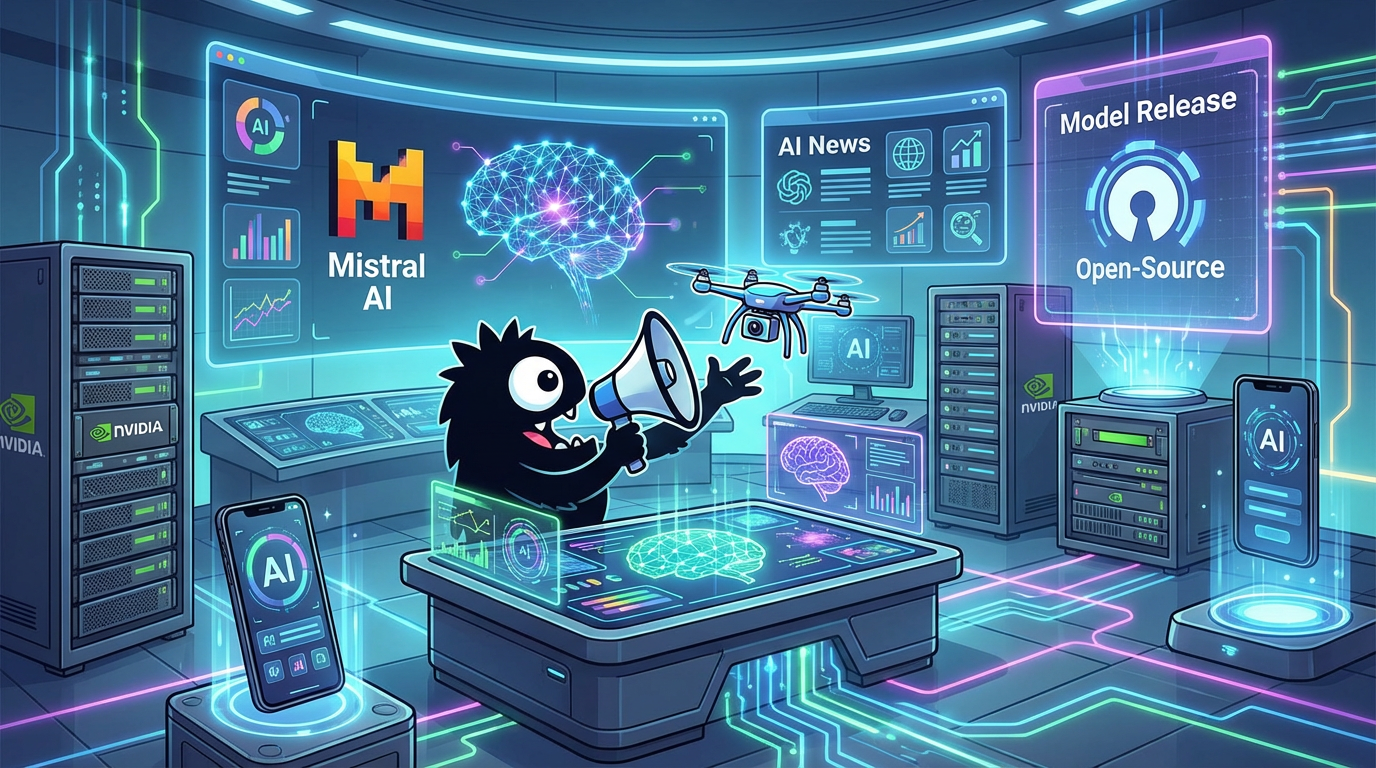
In an era where AI deployment demands efficiency without sacrificing capability, Mistral AI's Mistral 3 family delivers open-source models that run seamlessly on edge devices like smartphones and drones, while scaling to enterprise-grade inference on NVIDIA hardware. For developers and technical buyers, this means accessible, multimodal AI—handling text, images, and multilingual tasks—with benchmark-topping performance at a fraction of the compute cost of proprietary giants, empowering custom integrations without vendor lock-in.
What Happened
On December 2, 2025, Mistral AI unveiled the Mistral 3 open-source family, comprising the compact Ministral 3 series in 3B, 8B, and 14B parameter sizes—each with base, instruct, and reasoning variants featuring native image understanding—and the powerhouse Mistral Large 3, a 675B total parameter mixture-of-experts (MoE) model with 41B active parameters, including base and instruct versions (reasoning variant forthcoming). All models support over 40 languages and are optimized for low-latency, high-throughput applications, trained on NVIDIA Hopper GPUs and released under the Apache 2.0 license for full customization. They achieve state-of-the-art results, such as the 14B reasoning model scoring 85% on AIME '25 math benchmarks and Mistral Large 3 ranking #2 on the LMSYS Arena for open-source non-reasoning models. Availability spans platforms like Hugging Face, AWS Bedrock, Azure, and NVIDIA NIM, with optimized inference via vLLM and TensorRT-LLM for formats like NVFP4. [source](https://mistral.ai/news/mistral-3) This launch, covered extensively in press, underscores Europe's push in open AI innovation amid global advancements. [source](https://venturebeat.com/ai/mistral-launches-mistral-3-a-family-of-open-models-designed-to-run-on) [source](https://techcrunch.com/2025/12/02/mistral-closes-in-on-big-ai-rivals-with-mistral-3-open-weight-frontier-and-small-models/)
Why This Matters
For developers and engineers, Mistral 3's edge-optimized Ministral models enable on-device AI for IoT and mobile apps, reducing latency and costs compared to cloud-dependent alternatives, while the MoE architecture in Mistral Large 3 supports scalable, agentic workflows like coding assistants and document analysis with speculative decoding for long contexts. Technical buyers benefit from the best cost-to-performance ratio in open-source AI, matching closed models on benchmarks yet allowing fine-tuning and deployment flexibility across NVIDIA ecosystems—from Jetson to Blackwell—without licensing fees. Business-wise, this intensifies competition, democratizing frontier AI for enterprises wary of Big Tech dominance, fostering innovation in multilingual, multimodal tools and potentially slashing inference expenses by an order of magnitude. [source](https://blogs.nvidia.com/blog/mistral-frontier-open-models/) Early adopters via Hugging Face or Mistral's API can prototype rapidly, accelerating time-to-market for AI-driven products. [source](https://huggingface.co/collections/mistralai/ministral-3)
Technical Deep-Dive
Mistral AI's Mistral 3 family marks a significant evolution in open-source large language models (LLMs), emphasizing multimodal capabilities and edge deployment. The architecture builds on Mistral's grouped-query attention (GQA) and sliding window attention from prior iterations, now extended to support vision-language tasks. The family includes three dense Ministral 3 variants—3B, 8B, and 14B parameters—optimized for low-latency inference on consumer hardware like smartphones and drones. These models use a 32k vocabulary tokenizer (v3), enabling efficient processing of text and images with a 128k context window. The flagship Mistral Large 3 employs a mixture-of-experts (MoE) design with 675B total parameters (123B active), reducing computational overhead by activating only subsets of experts per token. This yields up to 2x inference speed gains over dense equivalents while maintaining Apache 2.0 open weights for full customization. Key improvements include uncensored fine-tuning (no built-in moderation) and native function calling support, where special tokens (5-9) denote tool invocations in instruct variants.
Benchmark performance positions Mistral 3 as a frontier contender. On LMSYS Chatbot Arena, Mistral Large 3 achieves 1418 Elo, ranking #2 among open-source non-reasoning models and #6 overall, outperforming Llama 3.1 405B in multilingual tasks (MMLU: 88.7% vs. 88.6%) but trailing slightly in math (GSM8K: 96.2% vs. 96.8%). Ministral 3 variants excel in efficiency: the 3B model surpasses Gemma 2 2B on vision benchmarks like VQAv2 (78.5% accuracy) and beats Qwen-VL-Max in edge scenarios, with 1.5x faster latency on mobile GPUs. Compared to DeepSeek v3, Large 3 edges out in coding (HumanEval: 92% vs. 91%) but lags in long-context retrieval (RAG: 85% vs. 87%). These gains stem from a 20% parameter efficiency boost via sparse MoE routing, validated on NVIDIA H100s for 10x throughput over Mistral Large 2.
API access remains seamless via Mistral's platform and Hugging Face, with no major structural changes from v0.3 endpoints. Developers can query models using the standard ChatCompletion format:
import requests
url = "https://api.mistral.ai/v1/chat/completions"
headers = {"Authorization": "Bearer YOUR_API_KEY"}
data = {
"model": "mistral-large-3",
"messages": [{"role": "user", "content": "Explain MoE architecture."}],
"max_tokens": 512,
"temperature": 0.7
}
response = requests.post(url, json=data, headers=headers)
print(response.json()["choices"]["message"]["content"])Pricing is aggressively competitive: $0.50 per million input tokens and $1.50 per million output for Large 3 (256k context), undercutting GPT-4o by 40% while supporting vision inputs at no extra cost. Ministral variants are free for local use, with API tiers starting at $0.10/M for embeds. Enterprise options include fine-tuning via La Plateforme, with SLAs for 99.9% uptime.
Integration favors developers with tools like vLLM for serving (e.g., python -m vllm.entrypoints.openai.api_server --model mistralai/Ministral-3B) and NVIDIA TensorRT-LLM for quantization (4-bit: 70% memory reduction). Edge deployment on Android/iOS leverages ONNX Runtime, enabling offline multimodal apps. Challenges include higher VRAM needs for Large 3 (480GB FP16), mitigated by MoE sparsity. Developer reactions praise the edge focus for indie projects, though some note it trails proprietary models in raw reasoning depth.[source](https://mistral.ai/news/mistral-3)[source](https://developer.nvidia.com/blog/nvidia-accelerated-mistral-3-open-models-deliver-efficiency-accuracy-at-any-scale/)[source](https://binaryverseai.com/mistral-3-review-benchmarks-api-pricing-install/)[source](https://news.ycombinator.com/item?id=46121889)
Developer & Community Reactions
What Developers Are Saying
Developers and technical users in the AI community have largely praised Mistral AI's release of the Mistral 3 open-source family, highlighting its accessibility, performance, and strategic importance for open-weight models. Bindu Reddy, CEO of Abacus.AI, noted the model's competitive edge and Mistral's growing influence: "Mistral just dropped Mistral 3, which is just slightly worse than DeepSeek v3.2 yesterday. Mistral, a French company, has more LLM developer mindshare than any US company. SHOCKING 😱" [source](https://x.com/bindureddy/status/1996433027241845094). Similarly, MD Fazal Mustafa, founder of Heva AI, emphasized its ecosystem value: "Mistral 3 — and it’s a massive moment for open-source AI. A full model family, from 3B → 675B parameters, all released under Apache 2.0... Open-source AI just took a huge leap forward." [source](https://x.com/the_mdfazal/status/1996150785613430862). Abraham Chengshuai Yang, an AI researcher, called it a "huge—especially for Europe. A serious alternative to the current wave of closed US giants," praising its NVIDIA optimizations and production readiness. [source](https://x.com/Chengshuai_Yang/status/1995974746098598379). Comparisons to alternatives like Llama or GPT were favorable for openness, though some noted it trails closed models in raw benchmarks.
Early Adopter Experiences
Early hands-on feedback from developers focuses on the models' efficiency for local and edge deployment. Wildminder, a physicist and programmer, shared practical challenges with integration: "Flux2 [dev] already in ComfyUI. fp8 model 35GB - Mistral 3 small fp8 18GB. I need a new SSD for all these recent releases." [source](https://x.com/wildmindai/status/1993359574142013749). This reflects excitement about the compact Ministral variants (3B-14B) running on consumer hardware, ideal for multimodal tasks. Cameron, a developer, highlighted benchmarks: "Mistral Large 3: #2 open-source non-reasoning model on LMArena, trained on 3000 H200s," noting its speed on NVIDIA systems via TensorRT-LLM. [source](https://x.com/cameron_pfiffer/status/1995944999784251753). AKHIL, documenting AI journeys, reported positive initial tests: "Mistral 3 just dropped and it’s huge for open source! ... The gap between closed & open models is closing fast." [source](https://x.com/Akhi_l__/status/1995883973856420209). Users appreciated the multilingual support and fine-tuning ease for real-world apps like on-premise workflows.
Concerns & Criticisms
While enthusiasm dominates, technical critiques center on performance gaps and evaluation integrity. Lisan al Gaib, an AI scaling expert, pointed to limitations in advanced capabilities: "Open-source is 9 months behind frontier labs on agentic, long-context reasoning tasks... the most recent scale-up in model size puts open-source further behind." [source](https://x.com/scaling01/status/1991665386513748172). They also questioned French government benchmarks: "The french government created an LLM leaderboard... rigged it so that Mistral Medium 3.1 would be at the top... Mistral 3.1 Medium > Claude 4.5 Sonnet." [source](https://x.com/scaling01/status/1987226193959993742). Developers like Bobby Lansing raised deployment hurdles for enterprises, though positively framing edge efficiency, while others worried about compute demands for the 675B MoE despite optimizations. Overall, concerns validate the need for independent evals amid rapid open-source progress.
Strengths
- Apache 2.0 open-source license allows unrestricted customization, commercial deployment, and avoidance of vendor lock-in, ideal for technical teams building proprietary solutions [source](https://mistral.ai/news/mistral-3).
- Ministral 3 small models (3B, 8B, 14B) lead in multimodal benchmarks, outperforming Qwen-VL and Gemma 3 in vision-language tasks while maintaining efficiency for edge devices [source](https://www.reddit.com/r/singularity/comments/1pcdgng/mistral_3_family_released_10_models_large_3_hits/).
- Mistral Large 3 achieves frontier-level performance (1418 Elo on LMSYS) at 8x lower cost than closed rivals, with NVIDIA optimizations enabling fast inference on consumer hardware [source](https://blogs.nvidia.com/blog/mistral-frontier-open-models/).
Weaknesses & Limitations
- Smaller Ministral models lag behind closed-source leaders like GPT-4o-mini in complex reasoning and coding benchmarks, potentially requiring more fine-tuning for production accuracy [source](https://techcrunch.com/2025/12/02/mistral-closes-in-on-big-ai-rivals-with-mistral-3-open-weight-frontier-and-small-models/).
- Mistral Large 3 struggles with tool calling, producing malformed outputs and failing to rank in top 10 on image-based evals like MMMU, limiting agentic workflows [source](https://x.com/_valsai/status/1996403571974394254).
- Real-world testing reveals looping or repetitive responses in Ministral variants, especially under resource constraints, which could disrupt edge deployments [source](https://x.com/Qnoox/status/1996451267862839305).
Opportunities for Technical Buyers
How technical teams can leverage this development:
- Deploy Ministral 3 on smartphones or IoT devices for low-latency, privacy-focused AI like real-time translation or image analysis without cloud dependency.
- Fine-tune Mistral Large 3 for enterprise multimodal apps, such as document processing with vision, cutting costs versus API-based closed models.
- Integrate with NVIDIA stacks for scalable hybrid setups, enabling rapid prototyping of custom agents in regulated industries like finance or healthcare.
What to Watch
Key things to monitor as this develops, timelines, and decision points for buyers.
Track independent evals on LMSYS Arena and Hugging Face for reliability gains, expected in community fine-tunes by Q1 2026. Watch multimodal expansions via Azure integrations for enterprise readiness. Regulatory scrutiny on open MoE models could impact EU adoption. For buyers: Pilot Ministral in edge prototypes now; commit to Large 3 if tool-calling patches emerge by March 2026, balancing open flexibility against closed-model consistency.
Key Takeaways
- Mistral 3 delivers a versatile family of open-source models, including compact 8B and 14B variants alongside larger frontier-class options, enabling deployment from edge devices like smartphones and drones to enterprise-scale systems.
- Multimodal capabilities support text, vision, and audio processing out-of-the-box, outperforming predecessors in benchmarks for multilingual tasks and efficiency.
- Apache 2.0 licensing ensures full customization without vendor lock-in, with optimizations for NVIDIA hardware accelerating inference up to 2x faster on consumer GPUs.
- Strong privacy and cost advantages for on-device AI, reducing reliance on cloud APIs while maintaining near-SOTA accuracy in coding, reasoning, and creative generation.
- Seamless integrations via Azure AI Foundry and Hugging Face make it production-ready, positioning Mistral as a viable European alternative to U.S.-dominated closed models.
Bottom Line
For technical decision-makers, Mistral 3 is a compelling upgrade if you're building cost-effective, privacy-focused AI applications—act now to prototype on edge hardware or migrate from proprietary models like GPT-4o mini. Its open weights and multimodal prowess close the gap with Big Tech frontiers without the ethical or regulatory baggage. Ignore if you're locked into hyperscaler ecosystems; wait only if you need ultra-large-scale training capabilities not yet matched here. Developers in mobile/IoT, enterprise R&D, and open-source communities should prioritize this for democratizing high-performance AI.
Next Steps
- Download the Mistral 3 models from Hugging Face (huggingface.co/mistralai) and benchmark against your workloads using the provided inference scripts.
- Deploy a test instance on Azure AI Foundry for enterprise validation—sign up at azure.microsoft.com/en-us/products/ai-services.
- Join the Mistral Discord or GitHub discussions to access fine-tuning guides and collaborate on custom adaptations.
References (50 sources)
- https://x.com/i/status/1995460245200437665
- https://x.com/i/status/1994541821427359842
- https://x.com/i/status/1995574010575532340
- https://x.com/i/status/1995774262662299881
- https://x.com/i/status/1994348541154894334
- https://x.com/i/status/1995881468799885364
- https://x.com/i/status/1995036536283205754
- https://x.com/i/status/1994346781904167311
- https://x.com/i/status/1995153093399298276
- https://x.com/i/status/1995668461541109827
- https://x.com/i/status/1994438923079077890
- https://x.com/i/status/1994459069185188276
- https://x.com/i/status/1995104644163358896
- https://x.com/i/status/1995912346540097773
- https://x.com/i/status/1995705921180446781
- https://x.com/i/status/1996289957539819665
- https://x.com/i/status/1995236281660416066
- https://x.com/i/status/1994434415183761871
- https://x.com/i/status/1995510189819359334
- https://x.com/i/status/1995804030841549032
- https://x.com/i/status/1995949854317818152
- https://x.com/i/status/1995526864702447814
- https://x.com/i/status/1996001253445566777
- https://x.com/i/status/1994444079480918236
- https://x.com/i/status/1995113668112204091
- https://x.com/i/status/1994044165047636072
- https://x.com/i/status/1995391467167391762
- https://x.com/i/status/1996199805492564131
- https://x.com/i/status/1995543607328047364
- https://x.com/i/status/1996259874498383990
- https://x.com/i/status/1996223342316073303
- https://x.com/i/status/1993355804112498731
- https://x.com/i/status/1995995036840841654
- https://x.com/i/status/1994922827208663383
- https://x.com/i/status/1996537190546129366
- https://x.com/i/status/1994333348127203381
- https://x.com/i/status/1995522203056746682
- https://x.com/i/status/1995452773425721779
- https://x.com/i/status/1995149548398784725
- https://x.com/i/status/1994354610673275131
- https://x.com/i/status/1994358650878480650
- https://x.com/i/status/1996157818815066546
- https://x.com/i/status/1996323684596744367
- https://x.com/i/status/1994483521230958690
- https://x.com/i/status/1995402576133488730
- https://x.com/i/status/1995876172874629319
- https://x.com/i/status/1996146559147282545
- https://x.com/i/status/1996562021689778431
- https://x.com/i/status/1995795280470389034
- https://x.com/i/status/1996034268959834479
Related Guides

Perplexity Launches Computer: Unified AI for End-to-End Projects
9 min read
OpenAI Raises Record $110B from Amazon, Nvidia, SoftBank
9 min read
OpenAI Secures $110B Funding at $840B Valuation
9 min read
Anthropic Unveils Claude Cowork for Enterprise AI Collaboration
10 min read