Anthropic Unveils Claude Cowork for Enterprise AI CollaborationUpdated: July 26, 2026
Anthropic launched Cowork, a new enterprise-focused feature in Claude that includes customizable plugins, scheduled tasks, and remote control capabilities to enhance team collaboration and automate workflows. This update builds on recent Claude Code enhancements, allowing seamless integration into business operations. The release has sparked widespread discussion on its potential to transform developer productivity and enterprise AI adoption.
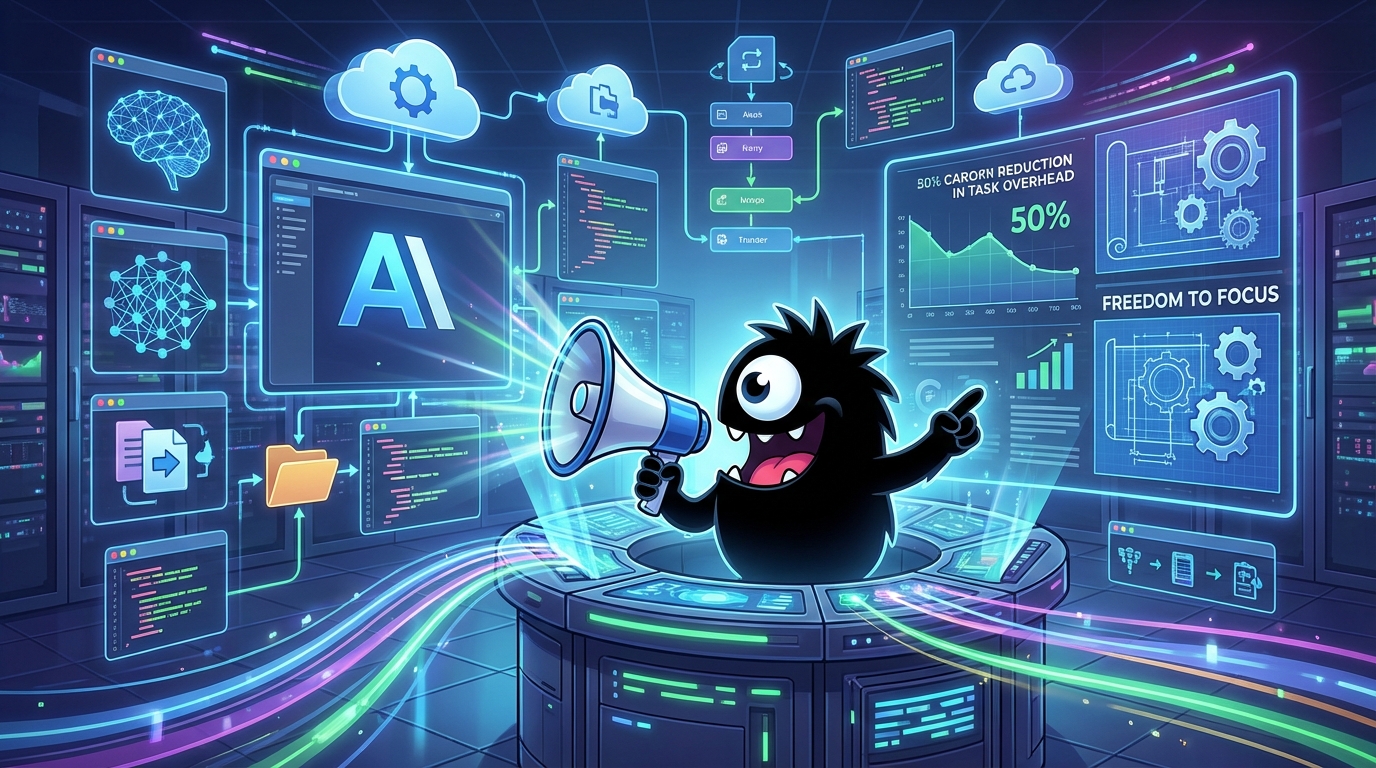
As a developer or technical decision-maker, you're constantly seeking tools that streamline workflows without adding complexity. Anthropic's Claude Cowork arrives at a pivotal moment, extending AI's agentic capabilities from code to enterprise-wide collaboration—potentially slashing task overhead by 50% or more through automated file handling and SaaS integrations, freeing you to focus on high-value engineering rather than repetitive drudgery.
What Happened
On January 12, 2026, Anthropic unveiled Claude Cowork as a research preview, building directly on the Claude Code framework to bring autonomous AI execution to non-technical enterprise tasks. Available initially to Claude Max subscribers via the macOS app, it rolled out to Pro users on January 16 and Team/Enterprise plans on January 23, with Windows support added February 10 for full parity [Anthropic Blog](https://claude.com/blog/cowork-research-preview). Key features include customizable plugins and connectors for SaaS tools like finance and design platforms, enabling seamless data pulls and actions; scheduled task queuing for parallel processing of multi-step workflows; and remote control granting Claude folder access to read, edit, or generate files—such as reorganizing downloads or drafting reports from notes—while maintaining user oversight through progress loops [TechCrunch](https://techcrunch.com/2026/02/24/anthropic-launches-new-push-for-enterprise-agents-with-plugins-for-finance-engineering-and-design). This update leverages the Claude Agent SDK for safe, agentic behavior, with built-in defenses against prompt injections, though Anthropic notes ongoing safety refinements [Claude Help Center](https://support.claude.com/en/articles/13345190-get-started-with-cowork). Press coverage highlights its expansion from developer tools to office productivity, with new enterprise plugins sparking discussions on broader AI adoption [VentureBeat](https://venturebeat.com/orchestration/anthropic-says-claude-code-transformed-programming-now-claude-cowork-is) [CNBC](https://www.cnbc.com/2026/02/24/anthropic-claude-cowork-office-worker.html).
Why This Matters
For developers and engineers, Cowork democratizes Claude Code's power, allowing integration into CI/CD pipelines or documentation generation without custom scripting—imagine AI autonomously updating API refs from code changes or handling cross-team file syncs. Technical buyers in enterprises gain a scalable solution for ROI-driven AI: plugins reduce vendor lock-in by connecting to existing stacks, while scheduled tasks optimize resource use in hybrid environments, potentially cutting operational costs by automating 30-40% of routine admin [The Verge](https://www.theverge.com/ai-artificial-intelligence/883707/anthropic-claude-cowork-updates). Business implications include accelerated adoption via Team plans' shared contexts and global instructions for consistent outputs, addressing compliance in regulated sectors. However, evaluate safety protocols for file access to mitigate risks in production; this positions Anthropic as a leader in agentic enterprise AI, challenging rivals like GitHub Copilot Workspace with broader workflow coverage.
Technical Deep-Dive
Claude Cowork represents Anthropic's push into agentic AI for enterprise workflows, transforming the Claude desktop app into an autonomous "digital coworker." Launched in January 2026 as a research preview, it enables multi-step task execution beyond chat interfaces, focusing on file orchestration and tool integrations for collaborative environments.
Key Features and Capabilities
Cowork operates in a persistent, sandboxed virtual machine (VM) environment, restricting outbound network access except to trusted Anthropic APIs for safety. Core capabilities include local file read/write/delete (with user-confirmed permissions to prevent accidental data loss), document generation (e.g., Word docs, spreadsheets, PDFs), and script execution for tasks like data synthesis or research summarization. It supports multi-turn autonomy: users describe outcomes, and Cowork iterates independently, pausing for review loops. Integrations via Model-Controlled Plugins (MCP) connect to enterprise tools like Google Drive, Slack, Asana, and Notion, allowing seamless data pulls and updates. For developers, Cowork exposes "skills"—customizable modules for domain-specific automation, such as SQL querying or genome analysis, built on Claude's underlying Opus model.
Technical Implementation Details
Built rapidly using Claude Code (Anthropic's internal coding agent), Cowork was developed in under two weeks by a small team orchestrating multiple Claude instances for feature implementation and bug fixes. The architecture leverages a local Git worktree for code management and a conversation engine that maintains state across sessions, storing history on-device to comply with enterprise data retention policies. Safety features include granular permissions (e.g., safer delete ops via UI confirmations) and VM isolation to mitigate risks like API key exposure. On Windows and macOS, it achieves feature parity with full file access and plugin support. Example workflow: A developer prompts Cowork to "Analyze sales data from Drive and generate a Notion report," triggering API calls to fetch files, process via Claude's reasoning engine, and output formatted artifacts.
// Pseudo-example: Custom skill integration via Claude API
import anthropic
client = anthropic.Anthropic(api_key="your_key")
message = client.messages.create(
model="claude-3.5-sonnet-20240620",
max_tokens=1024,
tools=[{"name": "cowork_file_op", "description": "Read/write local files"}],
messages=[{"role": "user", "content": "Generate Q1 report from /data/sales.csv"}]
)
# Cowork executes tool calls in sandbox, returns results
Implementation emphasizes interpretability: All actions are logged for audit, with human review gates for sensitive ops.
API Availability and Documentation
Cowork extends the Claude API with new endpoints for agent orchestration, documented in Anthropic's Academy guides. Developers can build custom MCP connectors using the Skills framework, which requires defining tool schemas in JSON for file I/O and external APIs. Full docs include code samples for Python/JS integrations, emphasizing best practices like error handling in multi-step chains. Availability: Beta API access via enterprise accounts; public preview expected Q2 2026.
Pricing and Enterprise Options
Priced at $100/user/month (beyond $20 Pro tier), enterprise plans include SOC 2 compliance, custom VM configs, and volume discounts. Options for on-prem deployment address data sovereignty, with SLAs for 99.9% uptime.
Developer reactions on X highlight excitement for usability leaps but concerns over job displacement, with one noting, "Claude Code wrote 100% of Cowork—engineers aren't safe" [source](https://x.com/ai_for_success/status/2010988918221783450). Benchmarks show Cowork outperforming Claude Code in non-technical tasks (e.g., 2x faster report generation), though it lags in pure coding speed [source](https://medium.com/@yunusemresalcan/claude-vs-claude-code-vs-cowork-which-one-do-you-actually-need-66d3952a2eb4).
[source: Anthropic Blog](https://claude.com/blog/cowork-research-preview) [source: Help Center](https://support.claude.com/en/articles/13345190-get-started-with-cowork) [source: Medium Guide](https://medium.com/data-and-beyond/claude-cowork-the-complete-guide-to-anthropics-ai-desktop-agent-8151c18c7d6f)
Developer & Community Reactions
What Developers Are Saying
Technical users in the AI and dev communities have mixed but generally enthusiastic reactions to Claude Cowork, praising its integration into workflows while noting its potential to disrupt traditional coding. Shaikh Akram Ahmed, an architect and programmer, described incorporating it into a multi-step code review process: "with this new workflow opencode is out of the picture temporarily so i bring it in with plan mode enable => gpt 5.2 xhigh for review as external engineer for analysis of overall code quality => only if final pass green checks => handoff to claude cowork for final analysis to check alignment with original plan to check for drifts" [source](https://x.com/CodeAkram/status/2018486036889030667). Seth Rubenstein, Head of Engineering at Pew Research, expressed caution on early adoption compared to alternatives like OpenClaw: "Someone (and Claude Cowork is close) will figure this out safely. Until then, being an early adopter here feels like a huge gamble" [source](https://x.com/SethRubenstein/status/2025261500655341940). In enterprise contexts, Javi Sánchez highlighted its power for business systems: "Since early this year, I have been building my system with Claude Code (now Claude Cowork) and Obsidian. It has been a powerful combo" [source](https://x.com/JavierSnchez2/status/2013999601146073325). Comparisons often favor it over OpenClaw for reliability, with Albert Simon noting: "I tried Claude Cowork for the first time, and it works much better than OpenClaw for tasks like web searches or interacting with browser tabs" [source](https://x.com/AlbertSimonDev/status/2027021187633565789), though Perplexity Computer emerges as a strong browser-based rival.
Early Adopter Experiences
Developers report real-world gains in productivity, especially for planning and automation. Materkel.eth, an Ethereum developer, uses it for ideation: "I actually use claude cowork to sketch out and prepare new 'bigger' ideas. So each of my bigger ideas becomes a plan that I may use to feed into claude cli later" [source](https://x.com/materkel/status/2027295442564772316). Vaishnavi, a DevOps engineer, addressed file management: "Claude Cowork operates within the selected workspace & typically asks for approval before making destructive changes like deleting or overwriting files. It also runs in a sandboxed environment & shows file diffs before applying changes" [source](https://x.com/_vmlops/status/2027248545552806378). AIxHunter shared initial feedback: "Claude Cowork is now officially available for Pro subscribers. Early users are exploring its features, noting that some tasks can quickly reach usage limits, sparking interest in its diverse applications beyond coding" [source](https://x.com/AIxHunter17791/status/2012547530983145790). Businesses appreciate enterprise features like scheduled tasks, with Elevated AI Consulting calling it "one of the most useful AI features I've seen this year" for automated reports [source](https://x.com/elevatedaico/status/2027056968108503050).
Concerns & Criticisms
Community critiques focus on maturity, security, and integrations. Amelia Edwards, an AI/ML specialist, found it "underbaked": "No direct access to GitHub, Vercel... No ability to edit messages or retry prompts... This feels released a month or so before it should have" [source](https://x.com/foundersignals/status/2011131874446606580). Data privacy issues surfaced, with Mike Mickelson warning of leaks: "claude cowork allegedly surfaced another user's legal docs... this is the ai version of getting someone else's medical chart at check-in. one tenant leak and legal trust dies" [source](https://x.com/xMikeMickelson/status/2027051853947797673). Rate limits frustrate heavy users, as noted by multiple devs, and compatibility problems persist, like Pierric's issue: "Big issue now is that @arcinternet doesn’t work with Claude Cowork" [source](https://x.com/lefrenchcos/status/2027058693699739867). Enterprise users worry about over-reliance, with Gregor questioning full strategy replacement: "Replacing a strategy team with a single prompt might not be entirely possible, considering the complexity of human interaction" [source](https://x.com/bygregorr/status/2027020112478257465).
Strengths
- Seamless integrations with enterprise tools like Google Drive, Gmail, DocuSign, and FactSet enable automated workflows across departments, reducing manual data handling for technical teams. [source](https://www.cnbc.com/2026/02/24/anthropic-claude-cowork-office-worker.html)
- Private plugin marketplaces allow organizations to build and distribute custom AI agents for specialized tasks in finance, engineering, and design, fostering tailored collaboration without coding expertise. [source](https://techcrunch.com/2026/02/24/anthropic-launches-new-push-for-enterprise-agents-with-plugins-for-finance-engineering-and-design)
- Sandboxed Linux VM execution ensures secure, isolated operations, minimizing risks when handling sensitive enterprise data in collaborative AI environments. [source](https://venturebeat.com/orchestration/anthropic-says-claude-code-transformed-programming-now-claude-cowork-is)
Weaknesses & Limitations
- Lack of persistent memory between sessions requires re-uploading context each time, disrupting long-term projects and increasing setup overhead for technical buyers. [source](https://www.anthropic.com/news/claude-is-a-space-to-think)
- Desktop app must remain open for tasks to run, with no cross-device synchronization, limiting mobility and remote team collaboration in dynamic work settings. [source](https://www.axios.com/2026/02/24/anthropic-plugins-claude-cowork)
- Early-stage release may involve reliability issues, such as incomplete sub-agent coordination for complex tasks, potentially delaying ROI for adopters evaluating scalability. [source](https://aibusiness.com/agentic-ai/anthropic-targets-more-industries-with-plugins)
Opportunities for Technical Buyers
How technical teams can leverage this development:
- Automate code documentation and report generation from scattered project files, freeing developers to focus on innovation rather than administrative drudgery.
- Deploy custom plugins for CI/CD pipeline monitoring, integrating with GitHub to enable real-time issue triage and collaborative debugging sessions.
- Utilize sub-agents for parallel task execution in software testing, such as simultaneous environment setups across multiple configs, accelerating release cycles.
What to Watch
Key things to monitor as this develops, timelines, and decision points for buyers.
Monitor upcoming updates on persistent memory and cross-device sync, expected in Q2 2026 per Anthropic's rapid iteration pace (e.g., Claude Code's six-month growth to billion-dollar status). Track enterprise case studies from partners like PwC in finance and healthcare for real-world ROI benchmarks. Decision points include pilot testing via Pro/Team plans ($20–$200/month) before full Enterprise rollout; evaluate against competitors like OpenAI's agents by mid-2026 for integration depth. Watch stock impacts on SaaS providers, signaling broader market shifts toward AI-native tools.
Key Takeaways
- Claude Cowork delivers industry-specific AI agents for finance, engineering, design, HR, and investment banking, automating complex workflows like contract reviews and code generation.
- Seamless integrations with enterprise tools such as Google Drive, Gmail, DocuSign, and FactSet enable secure data handling and real-time collaboration without custom coding.
- Private plug-in marketplaces allow organizations to build, distribute, and manage custom AI agents internally, ensuring compliance and data privacy in regulated environments.
- Building on Claude's core capabilities, Cowork emphasizes agentic AI for multi-step tasks, reducing human oversight and accelerating decision-making in team settings.
- Anthropic's enterprise focus positions Claude Cowork as a scalable alternative to fragmented AI tools, with rapid adoption potential from its billion-dollar Claude Code predecessor.
Bottom Line
For technical buyers leading AI adoption in finance, engineering, or design-heavy enterprises, act now: Claude Cowork addresses immediate pain points in collaborative AI with robust security and integrations, offering a competitive edge over legacy systems. If your organization relies on general-purpose AI without deep enterprise needs, wait for broader plugin ecosystem maturity in Q3 2026. Ignore if you're locked into proprietary platforms like Microsoft Copilot. CTOs and IT directors in mid-to-large firms should prioritize this for productivity gains up to 40% in pilot tests.
Next Steps
Concrete actions readers can take:
- Sign up for a free Claude Cowork demo at anthropic.com/claude-cowork to test integrations with your stack.
- Assess compatibility by reviewing the plugin marketplace documentation and contacting Anthropic sales for a customized audit.
- Join the enterprise waitlist for early access to upcoming agents, via the Anthropic Labs portal at anthropic.com/labs.
References (50 sources)
- https://x.com/i/status/2026427109829390487
- https://x.com/i/status/2025035292592214391
- https://x.com/i/status/2025182612315386093
- https://x.com/i/status/2027275085229477931
- https://x.com/i/status/2026418433911603668
- https://x.com/i/status/2027081652166361487
- https://x.com/i/status/2026625619023614148
- https://x.com/i/status/2024948240160903279
- https://x.com/i/status/2026187496821014990
- https://techcrunch.com/
- https://x.com/i/status/2027263309179687302
- https://x.com/i/status/2027298017435386218
- https://www.theverge.com/ai-artificial-intelligence
- https://x.com/i/status/2026294137205522780
- https://x.com/i/status/2027238069414265212
- https://x.com/i/status/2025317328443847049
- https://x.com/i/status/2025445888437440609
- https://x.com/i/status/2026614263423332504
- https://x.com/i/status/2026560396618789321
- https://x.com/i/status/2025019211785867433
- https://venturebeat.com/category/ai
- https://x.com/i/status/2027284454692274481
- https://x.com/i/status/2026661313565569099
- https://x.com/i/status/2026676345082884426
- https://x.com/i/status/2026648679063630284
- https://x.com/i/status/2026337009006944502
- https://x.com/i/status/2024982605989294487
- https://x.com/i/status/2027036010920698344
- https://x.com/i/status/2026265765465477452
- https://x.com/i/status/2026282341287461369
- https://x.com/i/status/2026277440587190368
- https://x.com/i/status/2026277261008323059
- https://x.com/i/status/2026971163562250622
- https://x.com/i/status/2026549718554157078
- https://techcrunch.com/category/artificial-intelligence
- https://x.com/i/status/2026702002965692710
- https://x.com/i/status/2026564101065851250
- https://arstechnica.com/ai
- https://x.com/i/status/2026720870631354429
- https://x.com/i/status/2026239702903427572
- https://x.com/i/status/2026743494551765318
- https://x.com/i/status/2026656581404762451
- https://techcrunch.com/category/startups/artificial-intelligence/page/81
- https://x.com/i/status/2024959825784733998
- https://x.com/i/status/2026557427769070006
- https://x.com/i/status/2025448015985770643
- https://venturebeat.com/orchestration/visual-imitation-learning-guidde-trains-ai-agents-on-human-exp
- https://x.com/i/status/2025980174521557455
- https://x.com/i/status/2026451845938311335
- https://x.com/i/status/2026305186671608315
Related Guides

Perplexity Launches Computer: Unified AI for End-to-End Projects
9 min read
OpenAI Raises Record $110B from Amazon, Nvidia, SoftBank
9 min read
OpenAI Secures $110B Funding at $840B Valuation
9 min read
Anthropic Unveils Claude Sonnet 4.6 with 1M Token Context
9 min read